Showing posts with label Immaculate Conception. Show all posts

Sunday, May 08, 2011

Immaculate Mary, the Virgin Mother

May is the month of Mary, and today is Mother's Day. So what better time than now, in our study of the Sacrament of Confirmation, to discuss our Blessed Mother Mary?

The Marian doctrines really say more about Jesus than it does about Mary herself. That is because, in all things, just as when she said at Cana, "do whatever He says," Mary always points us toward her Son.

But, at the same time, Mary also points towards ourselves. Or, more accurately, she points us to the people that God made us to be, the people we should strive to be. The entire life of Mary is not only a model, but the model for all of us. Her entire life, not merely her earthly life, but her eternal life is a model as well.
(1) Immaculate Conception – Full of Grace – Mary is the “New Eve,” who was redeemed and given the life of grace from the first moment of her conception, so that she was preserved from Original Sin or other sin in her life. The grace won by Christ on the Cross was applied to Mary in anticipation of this saving event. In this way, Mary could be a proper and pure “living temple” for the Son of God in her womb. “She is the living house of God, who does not dwell in buildings of stone but in the heart of living man.” – Pope Benedict XVI. It was this fullness of grace that gave Mary the total freedom, unimpaired by the errors of sin, to say “yes” to God at the Annunciation and throughout her life.

(2) Ever Virgin – The virgin birth of Jesus goes beyond merely demonstrating that the true Father of Jesus is God, not a man. Mary gave herself to God completely, in the entirety of her being, soul and body, including her perpetual virginity. This means that Mary was a virgin before the conception and birth of Jesus, during these events, and after these events. At once virgin and mother, Mary is the symbol and the most perfect realization of the Church, our pure and holy mother of all on earth, truly made in the image and likeness of the Triune God, a loving communion of persons that brings new life.

(3) Theotókos, the Mother of God – Mary is not merely mother of Jesus in His humanity or merely mother of the Christ, but is rightly called the Mother of God because Jesus is one, both fully human and fully God. The Lord dwelling within her, she is a living temple and Ark of the Covenant.

(4) Bodily Assumption into Heaven – At the end of her earthly life, Mary was assumed, body and soul, into heaven. She did not experience the corruption of the grave. Jesus being eternal, just as He is forever on the Cross, so too is He forever in the womb of Mary. And she is forever joined to her Son, so that if He is in heaven in the entirety of His being, soul and body, so too must His Mother Mary be in heaven in the entirety of her being, soul and body. The bodily assumption of Mary also points the way to all the faithful in the resurrection of the body.


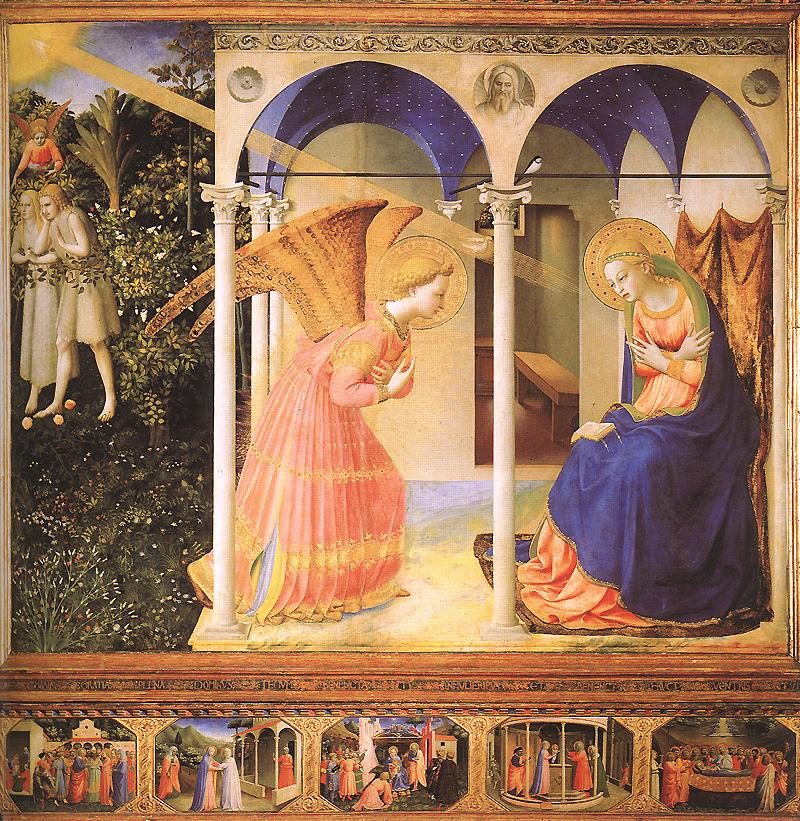
When he appears to Mary, the angel calls her "Full of Grace," as if that were her name. "Full of grace" describes not only who she is, but what she is. And it was the fullness of grace that gave Mary the total freedom, being unimpaired by the errors of sin, to say “yes” to God, in the fullness of her being, at the Annunciation and throughout her life.

Mary was not a mother in spite of her virginity, rather, she is a mother because of her virginity. In her perpetual virginity, she gave the entirety of herself to God, and it was because of the pureness and fullness of that love that Mary’s relationship with God was not only unitive, bringing her into communion with Him, but fruitful, such that a virgin could conceive and bear a Child.* In the mystery that is the all-powerful God who is in need of nothing yet choosing to need our help in the work of salvation, Mary, the New Eve, Virgin Mother of God and model of love, gave her very body to the Redeemer, without which there would have been no salvation.

In her fiat, Mary’s loving "Yes," the Handmaid of the Lord intimately carried Jesus within her very self. She clothed Him, fed Him, cared for Him, and followed Him even unto the Cross, where her heart was pierced, but where she also was made a gift to us all as our own "mother."

This same sacrifice of Jesus on the Cross, and His subsequent Resurrection, which, being eternal, that is, beyond human time, "worked backward" to the very conception of Mary in the womb of her holy mother Anne, so as to preserve her from Original Sin (the Immaculate Conception), also "worked forward" to the end of the Virgin's earthly journey, such that she might immediately know the resurrection of the body, rather than her body having to wait to the end of human time for the resurrection (bodily Assumption into heaven).

Mary is the "new Eve," the new mother of all of those who are truly living, that is, those who have eternal life. Just as she was our model in her earthly life, so too is Mary, now in the New Jerusalem, our model for eternal life. While we were not immaculately conceived in this worldly life, the faithful will be made pure so as to be immaculately conceived into eternal life.

She, the Queen of Heaven who is "with child" and "clothed with the sun," is the eschatological destiny for all the faithful. (Rev. 12:1-2) The bodily assumption of Mary into heaven anticipates the resurrection of the body of all of the faithful into a life full of grace in communion with He who is Love and Truth. We will not be bodily assumed into heaven, but we do profess a belief in the resurrection of the body. We who "die" in Christ Jesus will see our own bodies rise with Him in His Resurrection. On the last day, the old world will pass away, and those who remain faithful to Him, who are privileged to make themselves clean and pure in the Blood of the Lamb, will be raised up and given glorified bodies, fit to inhabit the New Jerusalem where Mary now dwells.
_________________

* Mary is the model of love. And through Mary, although so very little is said about him in the Gospels, we can see that her husband Joseph is also a model of love – true love – not the false so-called “love” of feelings and emotions, of merely making himself happy, of satisfying his own wants and desires, but true and complete love, the intense thirsting of purified eros and sacrificial gift of self of agape. The spousal love of Joseph for Mary, and the spousal love of Mary for Joseph, was made complete by their spousal love for God, and it was in that fullness of love that the virginal marriage of Joseph and Mary was both unitive and procreative. (See Bl. John Paul II, Theology of the Body)

The spousal meaning of the human body, male and female, is not merely one of complimentariness, but shows that we are made for relationships that are (a) unitive, which brings about, not simply a partnership, but communion with the other, a mystical transcendental joining with the other such that many become one, and (b) creative, a fruitfulness that is not limited to the biological (sexual), but is transcendent – it was by the love of the Logos that the universe itself was created, and it is by the fruitfulness of love that Jesus transforms death on the Cross into eternal life. In this way, although Mary and Joseph never “consummated” the marriage in the flesh (i.e. sexually), one can say that the marriage was a real marriage, made complete and whole spiritually, in the spirit of love. Their virginal marriage was unitive and fruitful in that very virginity, i.e. in their complete gift of self to God and, therefore, complete gift to each other, intimately receiving the other’s heart into his or her own person in the fullness of love.

The Holy Family is the “Church in miniature” and, together with Jesus, Joseph and Mary mirror the Trinity, a loving communion of three persons in one family, one body. Their spousal love resulted not only in communion with each other and God, but was fruitful — not only the Child they raised together and shared in spirit, if not the flesh (cf. St. Augustine, De nuptiis et concupiscentia, I:12-13), but also all those children who call His Father their Father.

_______________________

See also, The Blessing of the Virgin Mary, Mother of God

(Note - the above has been previously printed in various postings here and at Cinema Catechism.)
.

Wednesday, December 08, 2010

Immaculate Mary, Virgin Mother of God, Daughter of Her Son

Here is a piece that I wrote as a guest contributor for the blog Runs With Angels . . . Lives With Saints --

Today is the Solemnity of the Immaculate Conception.

The question immediately arises -- What is the "Immaculate Conception"?
Very simply, the doctrine states that the Blessed Virgin Mary is the “New Eve,” who was redeemed and given the life of the fullness of grace from the first moment of her existence, such that she was preserved from Original Sin at her conception. And, as noted in the prior posting on the Assumption of Mary, each of the four Marian doctrines are interrelated.

Why should Mary have been immaculately conceived?
When he appears to Mary, the angel calls her "Full of Grace," as if that were her name. "Full of grace" describes not only who she is, but what she is. It was the fullness of grace that gave Mary the total freedom, unimpaired by the errors of sin, to say “yes” to God, in the fullness of her being, at the Annunciation and throughout her life. In this way, Mary could be a proper and pure “living temple” for the Son of God in her womb. “She is the living house of God, who does not dwell in buildings of stone but in the heart of living man,” says Pope Benedict XVI. Moreover, in Jesus, God literally merged into mankind, becoming small, defenseless, and vulnerable while dwelling within the Virgin Mary’s womb, in the most intimate of relationships. Just as the first Eve was formed out of the first Adam, so Jesus, Son of God and the new Adam, was formed out of the new Eve, flesh of her flesh, bone of her bone. So, Jesus being the Lord, like us in all ways except sin, it was necessary that His flesh be pure and without the stain of sin.

An objection is raised by some Protestants that this somehow equates Mary to God and is a denial of the truth that we can be saved only by and through Jesus Christ. However, such objections do not understand the doctrine, which states that the grace won by Christ on the Cross was applied to Mary in anticipation of this saving event.

But how could Mary be saved by Jesus if He wasn't even born yet when she was conceived and the Crucifixion and Resurrection did not happen until about 45-50 years after that?

Although it would be impossible to gain the benefit of something before it existed in time from a human perspective, we must remember that God is eternal.

For us humans, time is linear, with a before, present, and future. But time is not linear for Jesus Christ, rather, He is eternal, all moments in time exist simultaneously, and each moment endures in perpetuity. Thus, at Mass, the sacrifice of Jesus that we celebrate is not something that happened 2000 years ago, but is happening right now, in the present. He is forever on the Cross, forever rising from the dead. And, just as that saving event extends "forward in time" for us, so too does it extend "backward in time" for Mary. Jesus is eternal, so when Mary was conceived, the Crucifixion and Resurrection were happening for Him.

The dogma of the Immaculate Conception, like all of the Marian doctrines, really says more about Jesus than it does about Mary herself. That is because, in all things, just as when she said at Cana, "do whatever He says," Mary always points us toward her Son.

But, at the same time, Mary also points towards ourselves. Or, more accurately, she points us to the people that God intended and intends for us to be. She is the "new Eve," the new mother of all of those who are truly living, that is, those who have eternal life. Just as her bodily assumption into heaven anticipates the resurrection of the body of all of the faithful, even if we ourselves will not be bodily assumed into heaven, so too does her immaculate conception anticipate our own "conception" into eternal life, a life full of grace in communion with He who is Love and Truth.

Although the faithful have professed a belief in the Immaculate Conception since the earliest days of the Church, and it has long been a feast day on the Church calendar, still it was not until 1854 that the doctrine was "formally" stated. That the dogma was not declared until that late date does not mean that it is a new teaching, to the contrary, it is because it has been the understanding and belief of the Church throughout the millenia that it could be formally ratified as doctrine.

Ineffabilis Deus
Apostolic Constitution on the Immaculate Conception

His Holiness Pope Pius IX, December 8, 1854

From the very beginning, and before time began, the eternal Father chose and prepared for his only-begotten Son, a Mother in whom the Son of God would become incarnate and from whom, in the blessed fullness of time, he would be born into this world. Above all creatures did God so love her that truly in her was the Father well pleased with singular delight. Therefore, far above all the angels and all the saints so wondrously did God endow her with the abundance of all heavenly gifts poured from the treasury of his divinity that this mother, ever absolutely free of all stain of sin, all fair and perfect, would possess that fullness of holy innocence and sanctity than which, under God, one cannot even imagine anything greater, and which, outside of God, no mind can succeed in comprehending fully. . . .

The Catholic Church, directed by the Holy Spirit of God, is the pillar and base of truth and has ever held as divinely revealed and as contained in the deposit of heavenly revelation this doctrine concerning the original innocence of the august Virgin -- a doctrine which is so perfectly in harmony with her wonderful sanctity and preeminent dignity as Mother of God. . . .

Accordingly, the Fathers have never ceased to call the Mother of God the lily among thorns, the land entirely intact, the Virgin undefiled, immaculate, ever blessed, and free from all contagion of sin, she from whom was formed the new Adam, the flawless, brightest, and most beautiful paradise of innocence, immortality and delights planted by God himself and protected against all the snares of the poisonous serpent, the incorruptible wood that the worm of sin had never corrupted, the fountain ever clear and sealed with the power of the Holy Spirit, the most holy temple, the treasure of immortality, the one and only daughter of life -- not of death -- the plant not of anger but of grace, through the singular providence of God growing ever green contrary to the common law, coming as it does from a corrupted and tainted root. . . .

To these praises they have added very noble words. Speaking of the conception of the Virgin, they testified that nature yielded to grace and, unable to go on, stood trembling. The Virgin Mother of God would not be conceived by Anna before grace would bear its fruits; it was proper that she be conceived as the first-born, by whom "the first-born of every creature" would be conceived. They testified, too, that the flesh of the Virgin, although derived from Adam, did not contract the stains of Adam, and that on this account, the most Blessed Virgin was the tabernacle created by God himself and formed by the Holy Spirit, truly a work in royal purple, adorned and woven with gold, which that new Beseleel made. They affirmed that the same Virgin is, and is deservedly, the first and especial work of God, escaping the fiery arrows of the evil one; that she is beautiful by nature and entirely free from all stain; that at her Immaculate Conception she came into the world all radiant like the dawn. For it was certainly not fitting that this vessel of election should be wounded by the common injuries, since she, differing so much from the others, had only nature in common with them, not sin. In fact, it was quite fitting that, as the Only-Begotten has a Father in heaven, whom the Seraphim extol as thrice holy, so he should have a Mother on earth who would never be without the splendor of holiness.

Tuesday, December 08, 2009

Mary Immaculate -- Purity Personified

Address of Pope Benedict XVI
Monument to the Immacolata, Piazza di Spagna

December 8, 2009


Dear Brothers and Sisters!

In the heart of Christian cities, Mary constitutes a sweet and reassuring presence. With her discreet style she gives everyone peace and hope in happy and sad moments of life. In the churches, in the chapels, on the walls of palaces: a painting, a mosaic, a statue recalls the presence of the Mother who constantly watches over her children.

Also here, in Piazza di Spagna, Mary is placed on high, almost to watch over Rome.

What does Mary say to the city? Of what does she remind everyone with her presence?

She reminds that "where sin increased, grace abounded all the more" (Romans 5:20) -- as the Apostle Paul writes. She is the Immaculate Mother who repeats also to the men of our time: Do not be afraid, Jesus has conquered evil; he has conquered it at the root, freeing us from its dominion.

How much we have need of this beautiful news! Every day, in fact, through newspapers, the television and the radio, evil is recounted, repeated, amplified, accustoming us to the most horrible things, making us become insensitive and, in some way, intoxicating us, because the negative is not fully disposed of and accumulates day after day. The heart hardens and thoughts become dark. Because of this, the city has need of Mary, who with her presence speaks to us of God, reminds us of the victory of grace over sin, and induces us to hope even in humanly more difficult situations.

In the city live - or survive - invisible persons, who every now and then leap onto the front page or on television screens, and are exploited to the end, so that the news and the image attract attention. It is a perverse mechanism, to which unfortunately one finds it hard to resist. The city first hides and then exhibits to the public, without pity, or with false pity. There is instead in every man the desire to be received as a person and considered a sacred reality, because every human history is a sacred history, and requires the greatest respect.

The city, dear brothers and sisters, is all of us! Each one contributes to its life and its moral climate, for good or evil. In the heart of every one of us passes the boundary between good and evil, and not one of us should feel the right to judge others, but rather each one must feel the duty to improve himself!

The mass media tends to make us feel always as "spectators," as if evil refers only to others, and certain things could never happen to us. Instead we are all "actors" and, in evil as in good, our behavior has an influence on others.

We often lament the pollution of the air, which in certain places of the city is unbreathable. It is true: We need everyone's commitment to make the city cleaner.

And yet, there is another pollution, less perceptible to the senses, but just as dangerous. It is the pollution of the spirit; it is that which renders our faces less smiling, more gloomy, which leads us not to greet one another, to not look at one another in the face. The city is made up of faces, but unfortunately the collective dynamics can make the perception of their depth disappear. We see everything on the surface. Persons become bodies, and these bodies lose the soul, become things, objects without a face, to be exchanged and consumed.

Mary Immaculate helps us to rediscover and defend the depth of persons, because in her there is perfect transparency of the soul in the body. She is purity personified, in the sense that the spirit, soul and body are in her, fully consistent between themselves and with the will of God. The Madonna teaches us to open ourselves to God's action, to look at others as he looks at them -- from the heart. And to look at them with mercy, with love, with infinite tenderness, especially those who are most alone, most looked down upon, most exploited. "Where sin increased, grace abounded all the more."

I wish to pay tribute publicly to all those who in silence, not with words, but with deeds, make an effort to practice this evangelical law of love, which sends the world forward. They are so many, also here in Rome, and rarely do they make news. Men and women of every age, who have understood that it is no use to condemn, to lament, to recriminate, but it is better to respond to evil with good. This changes things, it changes persons and, in consequence, improves society.

Dear Roman friends, and all of you who live in this city! While we are busy in daily activities, let us listen to Mary's voice. Let us hear her silent but pressing appeal. She says to each one of us: Where sin increased, grace can overflow, beginning precisely from your heart and your life! And the city will be more beautiful, more Christian, more human.

Thank you, Holy Mother, for this your message of hope. Thank you for your silent but eloquent presence in the heart of our city. Immaculate Virgin, "Salus Populi Romani," pray for us!
.

Mary, the New Eve:
The True Mother of All the Living

Catechesis of His Holiness Pope Benedict XVI
Angelus, Solemnity of her Immaculate Conception

December 8, 2009


Dear brothers and sisters!

On December 8, we celebrate one of the most beautiful feasts of the Blessed Virgin Mary: the Solemnity of her Immaculate Conception.

But what does it mean that Mary is the Immaculate? What does this title say to us?

First of all, let us refer to the liturgical texts for today, especially the great "fresco" from Chapter 3 of Genesis and the account of the Annunciation in the Gospel of Luke.

After the Original Sin, God turned to the serpent, who represents Satan, He curses him and adds a promise: "I will put enmity between you and the woman, and between your offspring and hers; He will strike at your head, while you strike at his heel"(Gn 3:15). It is the announcement of a rematch: Satan in the dawn of Creation appears to have prevailed, but a Son of woman would come who would crush his head. Thus, through the woman's race, God Himself would triumph.

That woman is the Virgin Mary, of whom was born Jesus Christ, who with His sacrifice, defeated the old tempter once and for all. That is why, in so many paintings or statues of the Immaculate, she is shown crushing a serpent under her foot.

The evangelist Luke, on the other hand, shows us the Virgin Mary as she receives the announcement of the celestial messenger (cfr Lk 1:26-38). She appears as the humble authentic daughter of Israel, the true Zion in whom God wishes to make His dwelling.

She is the shoot from which the Messiah would be born, the just and merciful King. In the simplicity of the home in Nazareth, there lived the pure remnant of Israel, in whom God wished His people to be reborn, like a new tree that would extend its branches over the whole world, offering the good fruits of salvation to all men.

Unlike Adam and Eve, Mary remains obedient to the will of the Lord, and with all her being she says "Yes" and places herself fully at the disposition of divine design. She is the new Eve, the true "mother of all the living," who, through faith in Christ, will receive eternal life.

Dear friends, what immense joy to have Mary Immaculate for our mother!

Everytime we experience our fragility and any hint of evil, we can turn to her, and our hearts will receive light and comfort. Even in the trials of life, in the tempests that may make our faith and hope waver, let us think that we are her children and that the roots of our existence are anchored in the infinite grace of God.

The Church itself, although it is exposed to the negative influences of the world, always finds in her the star to orient herself and to follow the way indicated by Christ. Mary is, in fact, the Mother of the Church, as Pope Paul VI and the Second Vatican Council solemnly proclaimed.

Therefore, as we give thanks to God for this stupendous sign of His goodness, let us entrust to the Immaculate Virgin each of us, our families and communities, the whole Church and the whole world.
.

Quiz Time!

On this, the Solemnity of the Immaculate Conception (what is that again?), it is fitting to have a little fun in playing a game about Mary. For each right answer, your team gets a point or a prize (a Hersey's Hugs or candy cane or something).


1. Was Mary baptized/confirmed? If so, where and when? If not, why not?


2. Was John the Baptist baptized? If so, where and when? If not, why not?


3. Where is Mary buried?


4. How many children did Mary have after Jesus was born?


5. At the Annunciation, Mary said “yes” to God, “I am the handmaid of the Lord. Let it be done unto me according to thy word.” How does the “fiat” reflect Mary’s entire life?


6. How old was Mary at the time of the Annunciation? And was she exactly the same person afterwards as she was before?


7. In Jesus, God became small, defenseless, and vulnerable while dwelling within the Virgin Mary’s womb. The all-powerful God who is dependent upon no one chose to be dependent upon Mary in the work of salvation. How does Mary’s experience of carrying Jesus in the womb apply to Catholics who have received the Sacrament of Confirmation?


8. The angel announced to Mary that she would conceive by the power of the Holy Spirit. Where did/does the body of Jesus come from? What does He look like? Whose face does He have?


9. Jesus is both fully man and fully God, but Mary, His mother, is not God. Therefore, true or false – Mary is mother only of that human part of Jesus?


10. Mary is “full of grace.” Did the grace conferred upon Mary deprive her of free will, could she have declined when the angel told her that Jesus, the Son of God, would be born to her?


11. The crucifixion and resurrection of Jesus occurred nearly 50 years after Mary was conceived in the womb of her mother, St. Anne. Therefore, true or false, the crucifixion/resurrection could not possibly have had any effect on the conception of Mary?


12. On multiple occasions in the Gospel, Jesus refers to Mary as simply “Woman.” Was Jesus being disrespectful in calling His mother “Woman”?


13. Jesus, being God, is all-powerful. Therefore, true or false – with respect to Mary, Jesus is not bound by the Fourth Commandment to honor your mother and father?


14. Why and how is Mary “our mother”?


15. The Catholic Church is specially devoted to Mary. True or false – Catholics worship Mary and pray to her in the same way that one prays to God?


Answer key to be posted later.

Hail, Full of Grace

The Most Blessed Virgin Mary, the Handmaid of the Lord:
Mother of God, Daughter of her Son

Seventh Grade CCD – December 8, 2009

A. The Major Marian Doctrines

(1) Immaculate Conception – “Full of Grace”
Mary is the “New Eve,” who was redeemed and given the life of grace from the first moment of her conception, so that she was preserved from Original Sin or other sin in her life. The grace won by Christ on the Cross was applied to Mary in anticipation of this saving event. In this way, Mary could be a proper and pure “living temple” for the Son of God in her womb. “She is the living house of God, who does not dwell in buildings of stone but in the heart of living man.” – Pope Benedict XVI. It was this fullness of grace that gave Mary the total freedom, unimpaired by the errors of sin, to say “yes” to God at the Annunciation and throughout her life.

(2) Ever Virgin
The virgin birth of Jesus goes beyond merely demonstrating that the true Father of Jesus is God, not a man. Mary gave herself to God completely, in the entirety of her being, soul and body, including her perpetual virginity. This means that Mary was a virgin before the conception and birth of Jesus, during these events, and after these events. At once virgin and mother, Mary is the symbol and the most perfect realization of the Church, our pure and holy mother of all on earth.

(3) Theotókos, the Mother of God
Mary is not merely mother of Jesus in His humanity or merely mother of the Christ, but is rightly called the Mother of God because Jesus is one, both fully human and fully God. The Lord dwelling within her, she is a living temple and Ark of the Covenant.

(4) Bodily Assumption into Heaven
At the end of her earthly life, Mary was assumed, body and soul, into heaven. She did not experience the corruption of the grave. Jesus being eternal, just as He is forever on the Cross, so too is He forever in the womb of Mary, and she is forever joined to Christ, so that if He is in heaven in the entirety of His being, soul and body, so too must Mary be in heaven in the entirety of her being, soul and body. The bodily assumption of Mary also points the way to all the faithful in the resurrection of the body.

B. Mother of the Church, wholly united with her Son

(1) The Annunciation
“This scene is perhaps the pivotal moment in the history of God's relationship with his people. During the Old Testament, God revealed himself partially, gradually, as we all do in our personal relationships. It took time for the chosen people to develop their relationship with God. The Covenant with Israel was like a period of courtship, a long engagement. Then came the definitive moment, the moment of marriage, the establishment of a new and everlasting covenant. As Mary stood before the Lord, she represented the whole of humanity. In the angel's message, it was as if God made a marriage proposal to the human race. And in our name, Mary said ‘yes.’” – Pope Benedict XVI
In Jesus, God literally merged into mankind, becoming small, defenseless, and vulnerable while dwelling within the Virgin Mary’s womb, in the most intimate of relationships. Just as the first Eve was formed out of the first Adam, so Jesus, Son of God and the new Adam, was formed out of the new Eve, flesh of her flesh, bone of her bone.

(2) The Nativity of Our Lord
In the birth of Jesus, we not only see a God who has made Himself small, we see a God who has a face, and it is the face of His mother, Mary, who had carried Him in her womb. To show that such an intimate relationship with Jesus was not meant to be Mary's alone, to show that all the faithful are called to intimately receive Him into our own bodies, the newborn Jesus was placed in a manger. As with the straw that was food for the animals, so too Jesus is shown to be food for us in the Eucharist. And by becoming small in this way, the all-powerful God who needs nothing chose to need us, chose to need our help in bringing about the salvation of man.

(3) The Hidden Life of the Holy Family
The persons closest to Jesus are Mary and Joseph, who raised Jesus, fed Him, clothed Him, taught Him, including instruction in the Faith, and who comforted Him when He needed comforting. They devoted the entirety of their lives to guarding and protecting Jesus, and thereby join in His mission of redemption.

(4) Wedding at Cana
Mary, the handmaid of the Lord, by becoming His mother, became our mother too. As our Mother, like at Cana when the wine ran out, Mary is sensitive and attentive to our needs, and she intercedes and asks her Son to provide for us. (Jn. 2:1-5)

(5) Mother of Sorrows – Mother of Mercy
When the baby Jesus was presented to the Lord in the Temple, the righteous Simeon came to Mary and prophesied that a “sword would pierce her heart,” that is, she would know sorrow. Indeed, soon thereafter, Herod sought to kill Jesus and they were forced to flee to Egypt. During the Passion of her Son, Mary and faithfully persevered in her union with Him. There she stood, in keeping with the divine plan, enduring with her only begotten Son the intensity of His suffering, joining herself with His sacrifice in her mother's heart.

(6) Pentecost and the Early Church
Mary is the New Eve, the mother of all who live according to the life of grace. Jesus gave Mary to His followers to be our mother. She is the mother of the Church. Mary was present, praying with the Apostles and other disciples at Pentecost, when the Holy Spirit descended upon the faithful and the Church was born. “Mary is so interwoven in the great mystery of the Church that she and the Church are inseparable, just as she and Christ are inseparable. Mary mirrors the Church, anticipates the Church in her person, and in all the turbulence that affects the suffering, struggling Church she always remains the Star of salvation.” – Pope Benedict XVI

(7) Mary and Us
“Dear young people, we too must remain faithful to the ‘yes’ that we have given to the Lord's offer of friendship. We know that He will never abandon us. We know that He will always sustain us through the gifts of the Spirit. Mary accepted the Lord's ‘proposal’ in our name. So let us turn to her and ask her to guide us as we struggle to remain faithful to the life-giving relationship that God has established with each one of us. She is our example and our inspiration, she intercedes for us with her Son, and with a mother's love she shields us from harm.” – Pope Benedict XVI
.

Saturday, September 30, 2006

Dogmatic Definition of the Immaculate Conception

Ineffabilis Deus
Apostolic Constitution on
the Immaculate Conception
His Holiness Pope Pius IX, December 8, 1854


God ineffable -- whose ways are mercy and truth, whose will is omnipotence itself, and whose wisdom "reaches from end to end mightily, and orders all things sweetly" -- having foreseen from all eternity the lamentable wretchedness of the entire human race, which would result from the sin of Adam, decreed, by a plan hidden from the centuries, to complete the first work of his goodness by a mystery yet more wondrously sublime through the Incarnation of the Word. This he decreed in order that man who, contrary to the plan of Divine Mercy had been led into sin by the cunning malice of Satan, should not perish; and in order that what had been lost in the first Adam would be gloriously restored in the Second Adam. From the very beginning, and before time began, the eternal Father chose and prepared for his only-begotten Son, a Mother in whom the Son of God would become incarnate and from whom, in the blessed fullness of time, he would be born into this world. Above all creatures did God so love her that truly in her was the Father well pleased with singular delight. Therefore, far above all the angels and all the saints so wondrously did God endow her with the abundance of all heavenly gifts poured from the treasury of his divinity that this mother, ever absolutely free of all stain of sin, all fair and perfect, would possess that fullness of holy innocence and sanctity than which, under God, one cannot even imagine anything greater, and which, outside of God, no mind can succeed in comprehending fully. * * *

LITURGICAL ARGUMENT
The Catholic Church, directed by the Holy Spirit of God, is the pillar and base of truth and has ever held as divinely revealed and as contained in the deposit of heavenly revelation this doctrine concerning the original innocence of the august Virgin -- a doctrine which is so perfectly in harmony with her wonderful sanctity and preeminent dignity as Mother of God -- and thus has never ceased to explain, to teach and to foster this doctrine age after age in many ways and by solemn acts. From this very doctrine, flourishing and wondrously propagated in the Catholic world through the efforts and zeal of the bishops, was made very clear by the Church when she did not hesitate to present for the public devotion and veneration of the faithful the Feast of the Conception of the Blessed Virgin. By this most significant fact, the Church made it clear indeed that the conception of Mary is to be venerated as something extraordinary, wonderful, eminently holy, and different from the conception of all other human beings -- for the Church celebrates only the feast days of the saints. * * *

ORDINARY TEACHING OF THE ROMAN CHURCH
These truths, so generally accepted and put into practice by the faithful, indicate how zealously the Roman Church, mother and teacher of all Churches, has continued to teach this doctrine of the Immaculate Conception of the Virgin. Yet the more important actions of the Church deserve to be mentioned in detail. For such dignity and authority belong to the Church that she alone is the center of truth and of Catholic unity. It is the Church in which alone religion has been inviolably preserved and from which all other Churches must receive the tradition of the Faith.

The same Roman Church, therefore, desired nothing more than by the most persuasive means to state, to protect, to promote and to defend the doctrine of the Immaculate Conception. This fact is most clearly shown to the whole world by numerous and significant acts of the Roman Pontiffs, our predecessors. To them, in the person of the Prince of the Apostles, were divinely entrusted by Christ our Lord, the charge and supreme care and the power of feeding the lambs and sheep; in particular, of confirming their brethren, and of ruling and governing the universal Church. * * *

TESTIMONIES OF TRADITION
And indeed, illustrious documents of venerable antiquity, of both the Eastern and the Western Church, very forcibly testify that this doctrine of the Immaculate Conception of the most Blessed Virgin, which was daily more and more splendidly explained, stated and confirmed by the highest authority, teaching, zeal, knowledge, and wisdom of the Church, and which was disseminated among all peoples and nations of the Catholic world in a marvelous manner -- this doctrine always existed in the Church as a doctrine that has been received from our ancestors, and that has been stamped with the character of revealed doctrine. For the Church of Christ, watchful guardian that she is, and defender of the dogmas deposited with her, never changes anything, never diminishes anything, never adds anything to them; but with all diligence she treats the ancient documents faithfully and wisely; if they really are of ancient origin and if the faith of the Fathers has transmitted them, she strives to investigate and explain them in such a way that the ancient dogmas of heavenly doctrine will be made evident and clear, but will retain their full, integral, and proper nature, and will grow only within their own genus -- that is, within the same dogma, in the same sense and the same meaning. * * *

THE ANNUNCIATION
When the Fathers and writers of the Church meditated on the fact that the most Blessed Virgin was, in the name and by order of God himself, proclaimed full of grace by the Angel Gabriel when he announced her most sublime dignity of Mother of God, they thought that this singular and solemn salutation, never heard before, showed that the Mother of God is the seat of all divine graces and is adorned with all gifts of the Holy Spirit. To them Mary is an almost infinite treasury, an inexhaustible abyss of these gifts, to such an extent that she was never subject to the curse and was, together with her Son, the only partaker of perpetual benediction. Hence she was worthy to hear Elizabeth, inspired by the Holy Spirit, exclaim: "Blessed are you among women, and blessed is the fruit of your womb."

MARY COMPARED WITH EVE
Hence, it is the clear and unanimous opinion of the Fathers that the most glorious Virgin, for whom "he who is mighty has done great things," was resplendent with such an abundance of heavenly gifts, with such a fullness of grace and with such innocence, that she is an unspeakable miracle of God -- indeed, the crown of all miracles and truly the Mother of God; that she approaches as near to God himself as is possible for a created being; and that she is above all men and angels in glory. Hence, to demonstrate the original innocence and sanctity of the Mother of God, not only did they frequently compare her to Eve while yet a virgin, while yet innocence, while yet incorrupt, while not yet deceived by the deadly snares of the most treacherous serpent; but they have also exalted her above Eve with a wonderful variety of expressions. Eve listened to the serpent with lamentable consequences; she fell from original innocence and became his slave. The most Blessed Virgin, on the contrary, ever increased her original gift, and not only never lent an ear to the serpent, but by divinely given power she utterly destroyed the force and dominion of the evil one.

BIBLICAL FIGURES
Accordingly, the Fathers have never ceased to call the Mother of God the lily among thorns, the land entirely intact, the Virgin undefiled, immaculate, ever blessed, and free from all contagion of sin, she from whom was formed the new Adam, the flawless, brightest, and most beautiful paradise of innocence, immortality and delights planted by God himself and protected against all the snares of the poisonous serpent, the incorruptible wood that the worm of sin had never corrupted, the fountain ever clear and sealed with the power of the Holy Spirit, the most holy temple, the treasure of immortality, the one and only daughter of life -- not of death -- the plant not of anger but of grace, through the singular providence of God growing ever green contrary to the common law, coming as it does from a corrupted and tainted root. * * *

EXPLICIT AFFIRMATION OF A SUPEREMINENT SANCTITY
To these praises they have added very noble words. Speaking of the conception of the Virgin, they testified that nature yielded to grace and, unable to go on, stood trembling. The Virgin Mother of God would not be conceived by Anna before grace would bear its fruits; it was proper that she be conceived as the first-born, by whom "the first-born of every creature" would be conceived. They testified, too, that the flesh of the Virgin, although derived from Adam, did not contract the stains of Adam, and that on this account, the most Blessed Virgin was the tabernacle created by God himself and formed by the Holy Spirit, truly a work in royal purple, adorned and woven with gold, which that new Beseleel made. They affirmed that the same Virgin is, and is deservedly, the first and especial work of God, escaping the fiery arrows of the evil one; that she is beautiful by nature and entirely free from all stain; that at her Immaculate Conception she came into the world all radiant like the dawn. For it was certainly not fitting that this vessel of election should be wounded by the common injuries, since she, differing so much from the others, had only nature in common with them, not sin. In fact, it was quite fitting that, as the Only-Begotten has a Father in heaven, whom the Seraphim extol as thrice holy, so he should have a Mother on earth who would never be without the splendor of holiness. * * *

In the most holy liturgy and the Offices of the Church, * * * the Mother of God is invoked and praised as the one spotless and most beautiful dove, as a rose ever blooming, as perfectly pure, ever immaculate, and ever blessed. She is celebrated as innocence never sullied and as the second Eve who brought forth the Emmanuel. * * *

THE DEFINITION
Wherefore, in humility and fasting, we unceasingly offered our private prayers as well as the public prayers of the Church to God the Father through his Son, that he would deign to direct and strengthen our mind by the power of the Holy Spirit. In like manner did we implore the help of the entire heavenly host as we ardently invoked the Paraclete. Accordingly, by the inspiration of the Holy Spirit, for the honor of the Holy and undivided Trinity, for the glory and adornment of the Virgin Mother of God, for the exaltation of the Catholic Faith, and for the furtherance of the Catholic religion, by the authority of Jesus Christ our Lord, of the Blessed Apostles Peter and Paul, and by our own:
We declare, pronounce, and define that the doctrine which holds that the most Blessed Virgin Mary, in the first instance of her conception, by a singular grace and privilege granted by Almighty God, in view of the merits of Jesus Christ, the Savior of the human race, was preserved free from all stain of original sin, is a doctrine revealed by God and therefore to be believed firmly and constantly by all the faithful.

[Declaramus, pronuntiamus et definimus doctrinam quae tenet beatissimam Virginem Mariam in primo instanti suae conceptionis fuisse singulari Omnipotentis Dei gratia et privilegio, intuitu meritorum Christi Jesu Salvatoris humani generis, ab omni originalis culpae labe praeservatam immunem, esse a Deo revelatam, atque idcirco ab omnibus fidelibus firmiter constanterque credendam.]
Hence, if anyone shall dare -- which God forbid! -- to think otherwise than as has been defined by us, let him know and understand that he is condemned by his own judgment; that he has suffered shipwreck in the faith; that he has separated from the unity of the Church; and that, furthermore, by his own action he incurs the penalties established by law if he should dare to express in words or writing or by any other outward means the errors he thinks in his heart.

HOPED-FOR RESULTS
Our soul overflows with joy and our tongue with exultation. We give, and we shall continue to give, the humblest and deepest thanks to Jesus Christ, our Lord, because through his singular grace he has granted to us, unworthy though we be, to decree and offer this honor and glory and praise to his most holy Mother. All our hope do we repose in the most Blessed Virgin -- in the all fair and immaculate one who has crushed the poisonous head of the most cruel serpent and brought salvation to the world: in her who is the glory of the prophets and apostles, the honor of the martyrs, the crown and joy of all the saints; in her who is the safest refuge and the most trustworthy helper of all who are in danger; in her who, with her only-begotten Son, is the most powerful Mediatrix and Conciliatrix in the whole world; in her who is the most excellent glory, ornament, and impregnable stronghold of the holy Church; in her who has destroyed all heresies and snatched the faithful people and nations from all kinds of direst calamities; in her do we hope who has delivered us from so many threatening dangers. We have, therefore, a very certain hope and complete confidence that the most Blessed Virgin will ensure by her most powerful patronage that all difficulties be removed and all errors dissipated, so that our Holy Mother the Catholic Church may flourish daily more and more throughout all the nations and countries, and may reign "from sea to sea and from the river to the ends of the earth," and may enjoy genuine peace, tranquility and liberty. We are firm in our confidence that she will obtain pardon for the sinner, health for the sick, strength of heart for the weak, consolation for the afflicted, help for those in danger; that she will remove spiritual blindness from all who are in error, so that they may return to the path of truth and justice, and that here may be one flock and one shepherd.

Let all the children of the Catholic Church * * * fly with utter confidence to this most sweet Mother of mercy and grace in all dangers, difficulties, needs, doubts and fears. Under her guidance, under her patronage, under her kindness and protection, nothing is to be feared; nothing is hopeless. Because, while bearing toward us a truly motherly affection and having in her care the work of our salvation, she is solicitous about the whole human race. And since she has been appointed by God to be the Queen of heaven and earth, and is exalted above all the choirs of angels and saints, and even stands at the right hand of her only-begotten Son, Jesus Christ our Lord, she presents our petitions in a most efficacious manner. What she asks, she obtains. Her pleas can never be unheard.

Given at St. Peter's in Rome, the eighth day of December, 1854, in the eighth year of our pontificate.
Pius IX

Thursday, September 28, 2006

Mary the Immaculate Conception shows that by entrusting ourselves totally to God, we do not become God's puppet, but find true freedom.

Homily of His Holiness Pope Benedict XVI
Feast of the Immaculate Conception, December 8, 2005

What picture does [the Genesis passage regarding the Fall] show us? The human being does not trust God. Tempted by the serpent, he harbors the suspicion that in the end, God takes something away from his life, that God is a rival who curtails our freedom and that we will be fully human only when we have cast Him aside; in brief, that only in this way can we fully achieve our freedom. The human being lives in the suspicion that God's love creates a dependence and that he must rid himself of this dependency if he is to be fully himself.

Man does not want to receive his existence and the fullness of his life from God. He himself wants to obtain from the tree of knowledge the power to shape the world, to make himself a god, raising himself to God's level, and to overcome death and darkness with his own efforts. He does not want to rely on love that to him seems untrustworthy; he relies solely on his own knowledge since it confers power upon him. Rather than on love, he sets his sights on power, with which he desires to take his own life autonomously in hand. And in doing so, he trusts in deceit rather than in truth and thereby sinks with his life into emptiness, into death.

Love is not dependence but a gift that makes us live. The freedom of a human being is the freedom of a limited being, and therefore is itself limited. We can possess it only as a shared freedom, in the communion of freedom: only if we live in the right way, with one another and for one another, can freedom develop. We live in the right way if we live in accordance with the truth of our being, and that is, in accordance with God's will. For God's will is not a law for the human being imposed from the outside and that constrains him, but the intrinsic measure of his nature, a measure that is engraved within him and makes him the image of God, hence, a free creature.

If we live in opposition to love and against the truth - in opposition to God - then we destroy one another and destroy the world. Then we do not find life but act in the interests of death. All this is recounted with immortal images in the history of the original fall of man and the expulsion of man from the earthly Paradise.

Dear brothers and sisters, if we sincerely reflect about ourselves and our history, we have to say that with this narrative is described not only the history of the beginning but the history of all times, and that we all carry within us a drop of the poison of that way of thinking, illustrated by the images in the Book of Genesis. We call this drop of poison "original sin."

Precisely on the Feast of the Immaculate Conception, we have a lurking suspicion that a person who does not sin must really be basically boring and that something is missing from his life: the dramatic dimension of being autonomous; that the freedom to say no, to descend into the shadows of sin and to want to do things on one's own is part of being truly human; that only then can we make the most of all the vastness and depth of our being men and women, of being truly ourselves; that we should put this freedom to the test, even in opposition to God, in order to become, in reality, fully ourselves. In a word, we think that evil is basically good, we think that we need it, at least a little, in order to experience the fullness of being. * * * We think that a little bargaining with evil, keeping for oneself a little freedom against God, is basically a good thing, perhaps even necessary.

If we look, however, at the world that surrounds us we can see that this is not so; in other words, that evil is always poisonous, does not uplift human beings but degrades and humiliates them. It does not make them any the greater, purer or wealthier, but harms and belittles them.

This is something we should indeed learn on the day of the Immaculate Conception: the person who abandons himself totally in God's hands does not become God's puppet, a boring "yes man"; he does not lose his freedom. Only the person who entrusts himself totally to God finds true freedom, the great, creative immensity of the freedom of good. The person who turns to God does not become smaller but greater, for through God and with God he becomes great, he becomes divine, he becomes truly himself. The person who puts himself in God's hands does not distance himself from others, withdrawing into his private salvation; on the contrary, it is only then that his heart truly awakens and he becomes a sensitive, hence, benevolent and open person.

The closer a person is to God, the closer he is to people. We see this in Mary. The fact that she is totally with God is the reason why she is so close to human beings. For this reason, she can be the Mother of every consolation and every help, a Mother whom anyone can dare to address in any kind of need in weakness and in sin, for she has understanding for everything and is for everyone the open power of creative goodness. In her, God has impressed his own image, the image of the One who follows the lost sheep even up into the mountains and among the briars and thorn-bushes of the sins of this world, letting himself be spiked by the crown of thorns of these sins in order to take the sheep on his shoulders and bring it home. As a merciful Mother, Mary is the anticipated figure and everlasting portrait of the Son.

Thus, we see that the image of the Sorrowful Virgin, of the Mother who shares her suffering and her love, is also a true image of the Immaculate Conception. Her heart was enlarged by being and feeling together with God. In her, God's goodness came very close to us.

Mary thus stands before us as a sign of comfort, encouragement and hope. She turns to us, saying: "Have the courage to dare with God! Try it! Do not be afraid of him! Have the courage to risk with faith! Have the courage to risk with goodness! Have the courage to risk with a pure heart! Commit yourselves to God, then you will see that it is precisely by doing so that your life will become broad and light, not boring but filled with infinite surprises, for God's infinite goodness is never depleted!"

On this Feast Day, let us thank the Lord for the great sign of his goodness which he has given us in Mary, his Mother and the Mother of the Church. Let us pray to him to put Mary on our path like a light that also helps us to become a light and to carry this light into the nights of history. Amen.

Wednesday, September 27, 2006

Mary, the Immaculate Reflects and Prefigures the Church in her Person

Homily of His Holiness Pope Benedict XVI
Feast of the Immaculate Conception, December 8, 2005

The [Second Vatican] Council took place in a Marian setting, [which refers us] to the image of the Virgin who listens and lives in the Word of God, who cherishes in her heart the words that God addresses to her and, piecing them together like a mosaic, learns to understand them. It refers us to the great Believer who, full of faith, put herself in God's hands, abandoning herself to His will; it refers us to the humble Mother who, when the Son's mission so required, became part of it, and at the same time, to the courageous woman who stood beneath the Cross while the disciples fled. * * *

Not only does Mary have a unique relationship with Christ, the Son of God who, as man, chose to become her Son. Since she was totally united to Christ, she also totally belongs to us. Yes, we can say that Mary is close to us as no other human being is, because Christ becomes man for all men and women and His entire being is "being here for us." Christ, the Fathers said, as the Head, is inseparable from His Body which is the Church, forming with her, so to speak, a single living subject. The Mother of the Head is also the Mother of all the Church; she is, so to speak, totally emptied of herself; she has given herself entirely to Christ and with Him is given as a gift to us all. Indeed, the more the human person gives himself, the more he finds himself.

* * * Mary is so interwoven in the great mystery of the Church that she and the Church are inseparable, just as she and Christ are inseparable. Mary mirrors the Church, anticipates the Church in her person, and in all the turbulence that affects the suffering, struggling Church she always remains the Star of salvation. In her lies the true center in which we trust, even if its peri­ph­eries very often weigh on our soul. * * * [The] Petrine aspect of the Church, however, is included in that Marian aspect. In Mary, the Immaculate, we find the essence of the Church without distortion. We ourselves must learn from her to become "ecclesial souls," as the Fathers said, so that we too may be able, in accordance with St Paul's words, to present ourselves "blameless" in the sight of the Lord, as He wanted us from the very beginning.

But now we must ask ourselves: What does "Mary, the Immaculate" mean? Does this title have something to tell us? * * * Mary, the humble provincial woman who comes from a priestly race and bears within her the great priestly patrimony of Israel, is "the holy remnant" of Israel to which the prophets referred in all the periods of trial and darkness. In her is present the true Zion, the pure, living dwelling-place of God. In her the Lord dwells, in her He finds the place of His repose. She is the living house of God, who does not dwell in buildings of stone but in the heart of living man. * * * She is the offshoot from which grew the tree of redemption and of the redeemed. God has not failed, as it might have seemed formerly at the beginning of history with Adam and Eve or during the period of the Babylonian Exile, and as it seemed anew in Mary's time when Israel had become a people with no importance in an occupied region and with very few recognizable signs of its holiness. God did not fail. * * * Mary is holy Israel: she says "yes" to the Lord, she puts herself totally at His disposal and thus becomes the living temple of God. * * *

The closer a person is to God, the closer he is to people. We see this in Mary. The fact that she is totally with God is the reason why she is so close to human beings. For this reason she can be the Mother of every consolation and every help, a Mother whom anyone can dare to address in any kind of need in weakness and in sin, for she has understanding for everything and is for everyone the open power of creative goodness. In her, God has impressed his own image, the image of the One who follows the lost sheep even up into the mountains and among the briars and thorn-bushes of the sins of this world, letting himself be spiked by the crown of thorns of these sins in order to take the sheep on his shoulders and bring it home. As a merciful Mother, Mary is the anticipated figure and everlasting portrait of the Son.

Thus, we see that the image of the Sorrowful Virgin, of the Mother who shares her suffering and her love, is also a true image of the Immaculate Conception. Her heart was enlarged by being and feeling together with God. In her, God's goodness came very close to us. Mary thus stands before us as a sign of comfort, encouragement and hope. She turns to us, saying: "Have the courage to dare with God! Try it! Do not be afraid of him! Have the courage to risk with faith! Have the courage to risk with goodness! Have the courage to risk with a pure heart! Commit yourselves to God, then you will see that it is precisely by doing so that your life will become broad and light, not boring but filled with infinite surprises, for God's infinite goodness is never depleted!"

On this Feast Day, let us thank the Lord for the great sign of His goodness which He has given us in Mary, His Mother and the Mother of the Church. Let us pray to Him to put Mary on our path like a light that also helps us to become a light and to carry this light into the nights of history. Amen.