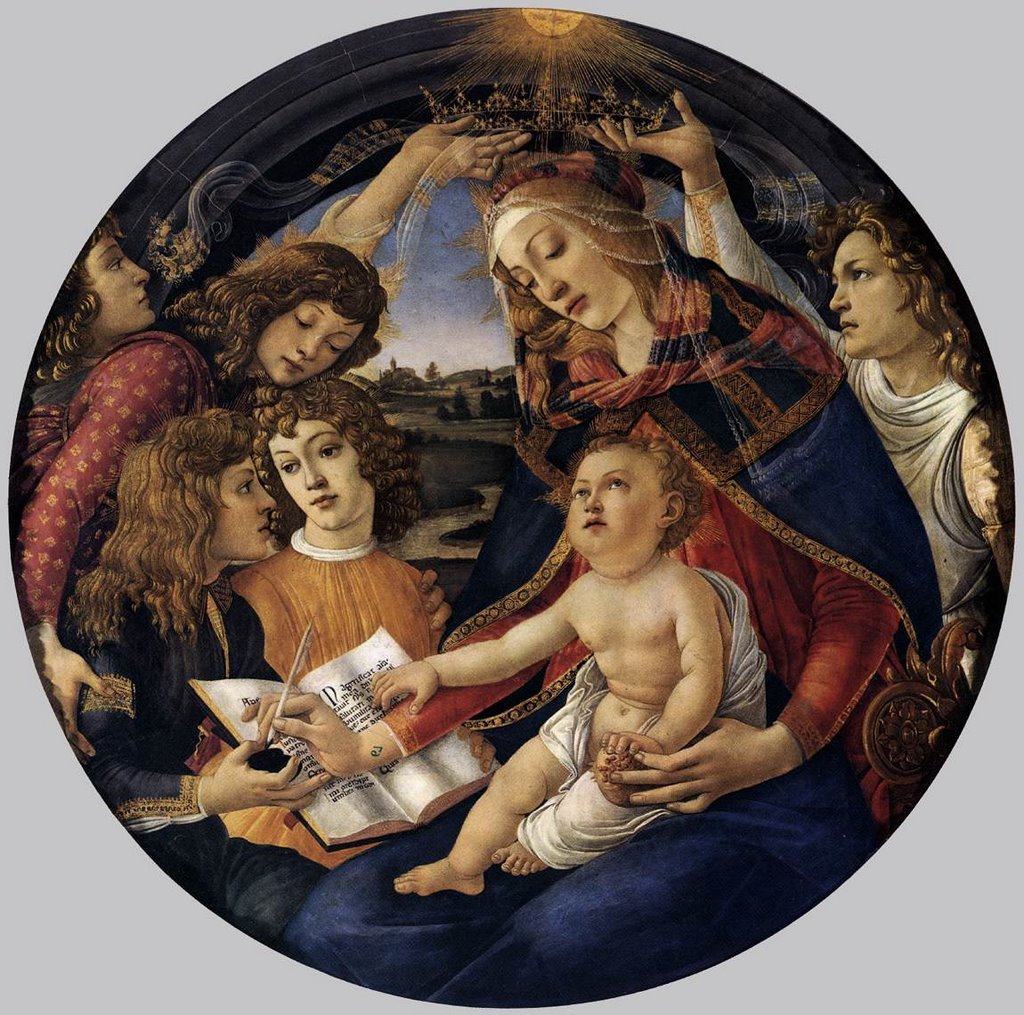
Read the rest of Her Immaculate Heart Will Triumph at Cinema Catechism.
Saturday, October 13, 2012
Her Immaculate Heart Will Triumph
Read the rest of Her Immaculate Heart Will Triumph at Cinema Catechism.
Sunday, May 13, 2012
Our Mother Mary: a Woman of Hope, a Woman of Faith, a Woman of Love
His Holiness Pope Benedict XVI
Solemnity of the Nativity of the Lord, December 25, 2005
41. Outstanding among the saints is Mary, Mother of the Lord and mirror of all holiness. In the Gospel of Luke we find her engaged in a service of charity to her cousin Elizabeth, with whom she remained for “about three months” so as to assist her in the final phase of her pregnancy.
“Magnificat anima mea Dominum”, she says on the occasion of that visit, “My soul magnifies the Lord.”In these words she expresses her whole program of life: not setting herself at the center, but leaving space for God, who is encountered both in prayer and in service of neighbor—only then does goodness enter the world. Mary's greatness consists in the fact that she wants to magnify God, not herself. She is lowly: her only desire is to be the handmaid of the Lord. She knows that she will only contribute to the salvation of the world if, rather than carrying out her own projects, she places herself completely at the disposal of God's initiatives.
Mary is a woman of hope: only because she believes in God's promises and awaits the salvation of Israel, can the angel visit her and call her to the decisive service of these promises.
Mary is a woman of faith: “Blessed are you who believed”, Elizabeth says to her. The Magnificat — a portrait, so to speak, of her soul — is entirely woven from threads of Holy Scripture, threads drawn from the Word of God. Here we see how completely at home Mary is with the Word of God, with ease she moves in and out of it. She speaks and thinks with the Word of God; the Word of God becomes her word, and her word issues from the Word of God. Here we see how her thoughts are attuned to the thoughts of God, how her will is one with the will of God. Since Mary is completely imbued with the Word of God, she is able to become the Mother of the Word Incarnate.
Finally, Mary is a woman who loves. How could it be otherwise? As a believer who in faith thinks with God's thoughts and wills with God's will, she cannot fail to be a woman who loves. We sense this in her quiet gestures, as recounted by the infancy narratives in the Gospel. We see it in the delicacy with which she recognizes the need of the spouses at Cana and makes it known to Jesus. We see it in the humility with which she recedes into the background during Jesus' public life, knowing that the Son must establish a new family and that the Mother's hour will come only with the Cross, which will be Jesus' true hour.
When the disciples flee, Mary will remain beneath the Cross; later, at the hour of Pentecost, it will be they who gather around her as they wait for the Holy Spirit.
42. The lives of the saints are not limited to their earthly biographies but also include their being and working in God after death. In the saints one thing becomes clear: those who draw near to God do not withdraw from men, but rather become truly close to them.
In no one do we see this more clearly than in Mary. The words addressed by the crucified Lord to his disciple—to John and through him to all disciples of Jesus: - “Behold, your mother!” (Jn 19:27) - are fulfilled anew in every generation. Mary has truly become the Mother of all believers.
Men and women of every time and place have recourse to her motherly kindness and her virginal purity and grace, in all their needs and aspirations, their joys and sorrows, their moments of loneliness and their common endeavours. They constantly experience the gift of her goodness and the unfailing love which she pours out from the depths of her heart. The testimonials of gratitude, offered to her from every continent and culture, are a recognition of that pure love which is not self- seeking but simply benevolent.
At the same time, the devotion of the faithful shows an infallible intuition of how such love is possible: it becomes so as a result of the most intimate union with God, through which the soul is totally pervaded by him — a condition which enables those who have drunk from the fountain of God's love to become in their turn a fountain from which “flow rivers of living water” (Jn 7:38).
Mary, Virgin and Mother, shows us what love is and whence it draws its origin and its constantly renewed power. To her we entrust the Church and her mission in the service of love:Holy Mary, Mother of God, you have given the world its true light, Jesus, your Son – the Son of God. You abandoned yourself completely to God's call and thus became a wellspring of the goodness which flows forth from him.
Show us Jesus. Lead us to him. Teach us to know and love him, so that we too can become capable of true love and be fountains of living water in the midst of a thirsting world.
Sunday, May 08, 2011
Immaculate Mary, the Virgin Mother
The Marian doctrines really say more about Jesus than it does about Mary herself. That is because, in all things, just as when she said at Cana, "do whatever He says," Mary always points us toward her Son.
But, at the same time, Mary also points towards ourselves. Or, more accurately, she points us to the people that God made us to be, the people we should strive to be. The entire life of Mary is not only a model, but the model for all of us. Her entire life, not merely her earthly life, but her eternal life is a model as well.
(1) Immaculate Conception – Full of Grace – Mary is the “New Eve,” who was redeemed and given the life of grace from the first moment of her conception, so that she was preserved from Original Sin or other sin in her life. The grace won by Christ on the Cross was applied to Mary in anticipation of this saving event. In this way, Mary could be a proper and pure “living temple” for the Son of God in her womb. “She is the living house of God, who does not dwell in buildings of stone but in the heart of living man.” – Pope Benedict XVI. It was this fullness of grace that gave Mary the total freedom, unimpaired by the errors of sin, to say “yes” to God at the Annunciation and throughout her life.
(2) Ever Virgin – The virgin birth of Jesus goes beyond merely demonstrating that the true Father of Jesus is God, not a man. Mary gave herself to God completely, in the entirety of her being, soul and body, including her perpetual virginity. This means that Mary was a virgin before the conception and birth of Jesus, during these events, and after these events. At once virgin and mother, Mary is the symbol and the most perfect realization of the Church, our pure and holy mother of all on earth, truly made in the image and likeness of the Triune God, a loving communion of persons that brings new life.
(3) Theotókos, the Mother of God – Mary is not merely mother of Jesus in His humanity or merely mother of the Christ, but is rightly called the Mother of God because Jesus is one, both fully human and fully God. The Lord dwelling within her, she is a living temple and Ark of the Covenant.
(4) Bodily Assumption into Heaven – At the end of her earthly life, Mary was assumed, body and soul, into heaven. She did not experience the corruption of the grave. Jesus being eternal, just as He is forever on the Cross, so too is He forever in the womb of Mary. And she is forever joined to her Son, so that if He is in heaven in the entirety of His being, soul and body, so too must His Mother Mary be in heaven in the entirety of her being, soul and body. The bodily assumption of Mary also points the way to all the faithful in the resurrection of the body.
When he appears to Mary, the angel calls her "Full of Grace," as if that were her name. "Full of grace" describes not only who she is, but what she is. And it was the fullness of grace that gave Mary the total freedom, being unimpaired by the errors of sin, to say “yes” to God, in the fullness of her being, at the Annunciation and throughout her life.
Mary was not a mother in spite of her virginity, rather, she is a mother because of her virginity. In her perpetual virginity, she gave the entirety of herself to God, and it was because of the pureness and fullness of that love that Mary’s relationship with God was not only unitive, bringing her into communion with Him, but fruitful, such that a virgin could conceive and bear a Child.* In the mystery that is the all-powerful God who is in need of nothing yet choosing to need our help in the work of salvation, Mary, the New Eve, Virgin Mother of God and model of love, gave her very body to the Redeemer, without which there would have been no salvation.
In her fiat, Mary’s loving "Yes," the Handmaid of the Lord intimately carried Jesus within her very self. She clothed Him, fed Him, cared for Him, and followed Him even unto the Cross, where her heart was pierced, but where she also was made a gift to us all as our own "mother."
This same sacrifice of Jesus on the Cross, and His subsequent Resurrection, which, being eternal, that is, beyond human time, "worked backward" to the very conception of Mary in the womb of her holy mother Anne, so as to preserve her from Original Sin (the Immaculate Conception), also "worked forward" to the end of the Virgin's earthly journey, such that she might immediately know the resurrection of the body, rather than her body having to wait to the end of human time for the resurrection (bodily Assumption into heaven).
Mary is the "new Eve," the new mother of all of those who are truly living, that is, those who have eternal life. Just as she was our model in her earthly life, so too is Mary, now in the New Jerusalem, our model for eternal life. While we were not immaculately conceived in this worldly life, the faithful will be made pure so as to be immaculately conceived into eternal life.
She, the Queen of Heaven who is "with child" and "clothed with the sun," is the eschatological destiny for all the faithful. (Rev. 12:1-2) The bodily assumption of Mary into heaven anticipates the resurrection of the body of all of the faithful into a life full of grace in communion with He who is Love and Truth. We will not be bodily assumed into heaven, but we do profess a belief in the resurrection of the body. We who "die" in Christ Jesus will see our own bodies rise with Him in His Resurrection. On the last day, the old world will pass away, and those who remain faithful to Him, who are privileged to make themselves clean and pure in the Blood of the Lamb, will be raised up and given glorified bodies, fit to inhabit the New Jerusalem where Mary now dwells.
_________________
* Mary is the model of love. And through Mary, although so very little is said about him in the Gospels, we can see that her husband Joseph is also a model of love – true love – not the false so-called “love” of feelings and emotions, of merely making himself happy, of satisfying his own wants and desires, but true and complete love, the intense thirsting of purified eros and sacrificial gift of self of agape. The spousal love of Joseph for Mary, and the spousal love of Mary for Joseph, was made complete by their spousal love for God, and it was in that fullness of love that the virginal marriage of Joseph and Mary was both unitive and procreative. (See Bl. John Paul II, Theology of the Body)
The spousal meaning of the human body, male and female, is not merely one of complimentariness, but shows that we are made for relationships that are (a) unitive, which brings about, not simply a partnership, but communion with the other, a mystical transcendental joining with the other such that many become one, and (b) creative, a fruitfulness that is not limited to the biological (sexual), but is transcendent – it was by the love of the Logos that the universe itself was created, and it is by the fruitfulness of love that Jesus transforms death on the Cross into eternal life. In this way, although Mary and Joseph never “consummated” the marriage in the flesh (i.e. sexually), one can say that the marriage was a real marriage, made complete and whole spiritually, in the spirit of love. Their virginal marriage was unitive and fruitful in that very virginity, i.e. in their complete gift of self to God and, therefore, complete gift to each other, intimately receiving the other’s heart into his or her own person in the fullness of love.
The Holy Family is the “Church in miniature” and, together with Jesus, Joseph and Mary mirror the Trinity, a loving communion of three persons in one family, one body. Their spousal love resulted not only in communion with each other and God, but was fruitful — not only the Child they raised together and shared in spirit, if not the flesh (cf. St. Augustine, De nuptiis et concupiscentia, I:12-13), but also all those children who call His Father their Father.
_______________________
See also, The Blessing of the Virgin Mary, Mother of God
(Note - the above has been previously printed in various postings here and at Cinema Catechism.)
.
Saturday, April 16, 2011
Novena to Our Lady of Lourdes
Given my affection for St. Bernadette, and inasmuch as health is so involved, physical and spiritual, I thought it appropriate to address our novena to Our Lady of Lourdes. Here is that novena (with litany), with the locations it was offered for that day --
Novena to Our Lady of Lourdes
+ Oh ever immaculate Virgin, Mother of Mercy, Health of the Sick, Refuge of Sinners, Comfortess of the Afflicted, you know our wants, our troubles, our sufferings. Look upon us with mercy. When you appeared in the grotto at Massabielle, you made it a privileged sanctuary where you dispense your favors, and where many sufferers have obtained the cure of their infirmities, both spiritual and corporal. We come, therefore, with unbounded confidence to implore your maternal intercession.
Our Lady of Lourdes, Mother of God, you had influence with your divine Son while upon earth. You have the same influence now in Heaven. Pray for us; obtain for us from your Divine Son our special requests for our loved ones if it be His divine will.
(specific prayer for that given day)
O Brilliant star of purity, Mary Immaculate, Our Lady of Lourdes, glorious in your assumption, triumphant in your coronation, show unto us the mercy of the Mother of God, Virgin Mary, Queen and Mother, be our comfort, hope, strength, and consolation. Amen.
Our Lady of Lourdes, help of Christians; Pray for them
Our Lady of Lourdes, source of love; Pray for them
Our Lady of Lourdes, mother of the poor; Pray for them
Our Lady of Lourdes, mother of the handicapped; Pray for them
Our Lady of Lourdes, mother of orphans; Pray for them
Our Lady of Lourdes, mother of all children; Pray for them
Our Lady of Lourdes, mother of all nations; Pray for them
Our Lady of Lourdes, mother of the Church; Pray for them
Our Lady of Lourdes, friend of the lonely; Pray for them
Our Lady of Lourdes, comforter of those who mourn; Pray for them
Our Lady of Lourdes, shelter of the homeless; Pray for them
Our Lady of Lourdes, guide of travelers; Pray for them
Our Lady of Lourdes, strength of the weak; Pray for them
Our Lady of Lourdes, refuge of sinners; Pray for them
Our Lady of Lourdes, comforter of the suffering; Pray for them
Our Lady of Lourdes, help of the dying; Pray for them
Blessed Virgin Mary, who can worthily repay you with praise and thanks for having rescued a fallen world by your generous consent! Receive our gratitude, and by your prayers obtain the pardon of our sins. Take our prayers into the sanctuary of heaven and enable them to make our peace with God. Amen.
St. Joseph, pray for us
St. Bernadette, pray for us
St. Andre Bessette, pray for us +
____________
DAY ONE (S. Maria Novella, Florence)
O Mary Immaculate, Our Lady of Lourdes, virgin and mother, queen of heaven, chosen from all eternity to be the Mother of the Eternal Word and in virtue of this title preserved from original sin, we kneel before you as did little Bernadette at Lourdes and pray with childlike trust in you that as we contemplate your glorious appearance at Lourdes, you will look with mercy on our present petition and secure for us a favorable answer to the request for which we are making this novena.
DAY TWO (Santa Croce, Florence)
Be blessed, O most pure Virgin, for having vouchsafed to manifest yourself shining with light, sweetness and beauty, in the Grotto of Lourdes, saying to the child Saint Bernadette: "I am the Immaculate Conception!" O Mary Immaculate, inflame our hearts with one ray of the burning love of your pure heart Let them be consumed with love for Jesus and for you, in order that we may merit one day to enjoy your glorious eternity. O dispenser of His graces here below, take into your keeping and present to your Divine Son the petition for which we are making this novena.
DAY THREE (S. Maria Maggiore, Rome)
"You are all fair, O Mary, and there is in you no stain of original sin." O Mary, conceived without sin, pray for us who have recourse to thee. O brilliant star of sanctity, as on that lovely day, upon a rough rock in Lourdes you spoke to the child Bernadette and a fountain broke from the plain earth and miracles happened and the great shrine of Lourdes began, so now I beseech you to hear our fervent prayer and do, we beseech you, grant us the petition we now so earnestly seek.
DAY FOUR (San Clemente, Rome)
O Immaculate Queen of Heaven, we your wayward, erring children, join our unworthy prayers of praise and thanksgiving to those of the angels and saints and your own-the One, Holy, and Undivided Trinity may be glorified in heaven and on earth. Our Lady of Lourdes, as you looked down with love and mercy upon Bernadette as she prayed her rosary in the grotto, look down now, we beseech you, with love and mercy upon us. From the abundance of graces granted you by your Divine Son, sweet Mother of God, give to each of us all that your motherly heart sees we need and at this moment look with special favor on the grace we seek in this novena.
DAY FIVE (San Paolo fuori le Mura, Rome)
O Mary Immaculate, Mother of God and our mother, from the heights of your dignity look down mercifully upon us while we, full of confidence in your unbounded goodness and confident that your Divine Son will look favorably upon any request you make of Him in our behalf, we beseech you to come to our aid and secure for us the favor we seek in this novena.
DAY SIX (Chapel of Residenza Madri Pie, Rome)
O glorious Mother of God, so powerful under your special title of Our Lady of Lourdes, to you we raise our hearts and hands to implore your powerful intercession in obtaining from the gracious Heart of Jesus all the helps and graces necessary for our spiritual and temporal welfare and for the special favor we so earnestly seek in this novena.
O Lady of Bernadette, with the stars of heaven in your hair and the roses of earth at your feet, look with compassion upon us today as you did so long ago on Bernadette in the Grotto of Lourdes.
DAY SEVEN (S. Agostino, Rome)
O Almighty God, who by the Immaculate Conception of the Blessed Virgin Mary did prepare a worthy dwelling place for your Son, we humbly beseech you that as we contemplate the apparition of Our Lady in the Grotto of Lourdes, we may be blessed with health of mind and body. O most gracious Mother Mary, beloved Mother of Our Lord and Redeemer, look with favor upon us as you did that day on Bernadette and intercede with him for us that the favor we now so earnestly seek may be granted to us.
DAY EIGHT (Residenza Madri Pie, Rome)
O Immaculate Mother of God, from heaven itself you came to appear to the little Bernadette in the rough Grotto of Lourdes! And as Bernadette knelt at your feet and the miraculous spring burst forth and as multitudes have knelt ever since before your shrine, O Mother of God, we kneel before you today to ask that in your mercy you plead with your Divine Son to grant the special favor we seek in this novena.
DAY NINE (St. Peter's Tomb, Basilica di San Pietro, Vatican)
O glorious Mother of God, to you we raise our hearts and hands to implore your powerful intercession in obtaining from the benign Heart of Jesus all the graces necessary for our spiritual and temporal welfare, particularly for the grace of a happy death. O Mother of our Divine Lord, as we conclude this novena for the special favor we seek at this time.
We feel animated with confidence that your prayers in our behalf will be graciously heard. O Mother of My Lord, through the love you bear to Jesus Christ and for the glory of His Name, hear our prayers and obtain our petitions.
___________________
*List of persons specifically prayed for by name:
Marilyn, Jamie, Brian, Jon, Melissa and their families
Rosemarie and Alan
Margie and Emerson
Departed loved ones -
-Edward and Doris
-Russell
-Milt
-Barb
-Neil, and their families
Rita, Dave, Stephen and their families
Dorothy and Gerald
Barb and Fred and their families
Karen and Stephen, Maureen and Andy, Kevin and Greta, Ann and Sam, Colleen and Mike, Tim and AnnMarie, and Melinda, and their families
Paul and Eva and their families
Fr. Cregan, Fr. Killian, Fr. Cramer, Msgr. Mahler, and their families
Susan, Richard, Sherry, Ernestine, and others and their families
My students, young and adult, and their families
Jan
Tuyen and Jody
Cathleen
Sharlene and their families
Daniel, Maxwell, Maureen, Shafica, Sherry, Tim, Gwen, and Lynn and their families
The Holy Father, all the bishops, priests, and religious, Sr. Jean Marian
Seminarians and others in religious formation
The President and other civic leaders
and Mark
Saturday, January 01, 2011
The Blessing of the Virgin Mary, Mother of God
May the Lord bless you and keep youThe readings for today, the Solemnity of the Most Blessed Virgin Mary, Mother of God, the Octave of Christmas, begin with a passage from Numbers 6:22-27, from which we get the above blessing, known as the Birkat Kohanim (Priestly Blessing) in Jewish worship.
May the Lord make His face to shine upon you and be gracious to you
May the Lord lift up His countenance upon you and grant you peace.
In Mary, Mother of God, the Lord has indeed blessed us and made His face to shine upon us and been gracious to us and lifted up His countenance upon us and granted us peace.
In her title of Theotókos (God bearer), we recognize that Mary is not merely mother of Jesus in His humanity or merely mother of the Christ (as some people had insisted in the early centuries of the Church), but she is rightly called the Mother of God because Jesus is one, both fully human and fully God. He is not half-God, half-man, and He is not divisible in His being. Rather, Jesus is fully God and fully man, two in one, and He always has been. His divinity did not enter into His Body at some later point, but upon the Incarnation of that Body at the Annunciation, when Mary conceived by the Holy Spirit. As such, Mary carries within her womb God Himself. The Lord Himself dwells within her, she is a living temple and Ark of the Covenant.
Dwelling with her, Mary takes Jesus to us, as she did when she visited Elizabeth and John the Baptist leapt for joy within his mother’s womb.
Born to her and receiving the shepherds and Magi, Mary invites us to come to Jesus. In the smiles of Baby Jesus, the Lord’s face shines upon us. And to show that an intimate relationship with Jesus was not meant to be her’s alone, to show that all the faithful are called to intimately receive Him into our own bodies, as she did, Mary placed the newborn Jesus in a manger. As with the straw that was food for the animals, so too Jesus is shown to be food for us in the Eucharist.
Taken by her to be circumcised on the eighth day, the octave of Christmas, Mary signifies His union with His people and His promises. Through that visible sign in the flesh, in the cutting of that physical instrument of human propagation, Jesus unites Himself to all generations and to the Covenant of the Lord. For those that accept Him and love Him, they will be His people and the Lord will be their God, and He will lead them to the land of eternal life and salvation.
Growing up with her, Mary provides for little Jesus, feeding Him, clothing Him, teaching Him, including instruction in the Faith, and comforting Him when He needs comforting. In raising Jesus our Savior, Mary protects and advances the work of salvation; devoting the entirety of her life to guarding and protecting Jesus, she thereby joins in His mission of redemption.
Joining her in the celebration of the wedding feast at Cana, Mary instructs us to do as her Son Jesus says. When the wine runs out in our lives, Mary is sensitive and attentive to our needs, and she intercedes and asks her Son to provide for us.
Raised above her on the Cross, Mary faithfully perseveres in her union with Jesus. There she stands at the foot of the Cross in keeping with the divine plan, enduring with her only begotten Son the intensity of His suffering, joining herself with His sacrifice in her mother’s heart. And Jesus makes explicit what is already implicit in her motherhood of Him, that she is our mother too. That, if we accept this adoption by Him and her, we too are children of the new Eve, the mother of those who truly live, those who live in Him.
In eternal communion with her, Mary prays with the faithful to Jesus and with Him as at Pentecost, when the Holy Spirit, long promised by the Lord, descended upon the faithful. As Pope Benedict has said,
Mary is so interwoven in the great mystery of the Church that she and the Church are inseparable, just as she and Christ are inseparable. Mary mirrors the Church, anticipates the Church in her person, and in all the turbulence that affects the suffering, struggling Church she always remains the Star of salvation.”In the face of the Virgin, we see the face of Jesus the Lord, so that when she smiles upon us, the face of the Lord shines upon us. On this Solemnity last year, Pope Benedict said,
The face is the expression par excellence of the person, namely, that which makes him recognizable and which shows his sentiments, thoughts and his heart’s intentions. God, by His nature, is invisible, but the Bible uses the image of the face even for Him. . . .The Lord has greatly blessed us and kept us with the gift that is His mother Mary. With her, His countenance is upon us, she is our life, our sweetness, and our hope. In Mary, Mother of God, the Queen of Peace, we can find peace ourselves.
All of Biblical narration can be read as the progressive revelation of the Face of God, until it reaches its full manifestation in Jesus Christ. “When the fullness of time had come,” the Apostle Paul reminds us even today, “God sent his Son,” adding right away, “born of a woman, born under the law” (Gal 4:4).
The face of God took on a human face, allowing Himself to be seen and recognized in the son of the Virgin Mary, whom we honor because of this with the most elevated title of “Mother of God.” She, who kept in her heart the secret of her divine motherhood, was the first to see the Face of God made man in the tiny fruit of her womb.
The mother has a very special relationship that is unique and somewhat exclusive with her newborn son. The first face that the baby sees is that of his mother, and this look is decisive for his relationship to life, with himself and with others, and with God. It is decisive, as well, so that he may become a “child of peace” (Lk 10:6).
Among the many typologies of the icon of the Virgin Mary in the Byzantine tradition, there is that which is called “tenderness” which shows the Baby Jesus with His face held, cheek to cheek, on His Mother’s. The Baby looks at the Mother, and she looks at us, almost reflecting to Him who observes, who prays, the tenderness of God, who had descended to her from heaven and incarnated in this Son of man that she carries in her arms.
In this Marian icon, we can contemplate something of God Himself: a sign of the ineffable love that impelled Him “to give His only begotten Son” (Jn 3:16). But the same icon also shows us, in Mary, the face of the Church which reflects on us and the entire world the light of Christ – the Church through which the good news comes to every man: “You are no longer slaves but children,” as we read from St. Paul. (Gal 4:7). . . .
__________________
See also The Smile of Mary is a True Reflection of God’s Tenderness and Source of Invincible Hope
(The foregoing was also posted as a guest contributor for the blog Runs With Angels . . . Lives With Saints.)
.
Wednesday, December 08, 2010
Immaculate Mary, Virgin Mother of God, Daughter of Her Son
Today is the Solemnity of the Immaculate Conception.
The question immediately arises -- What is the "Immaculate Conception"?
Very simply, the doctrine states that the Blessed Virgin Mary is the “New Eve,” who was redeemed and given the life of the fullness of grace from the first moment of her existence, such that she was preserved from Original Sin at her conception. And, as noted in the prior posting on the Assumption of Mary, each of the four Marian doctrines are interrelated.
Why should Mary have been immaculately conceived?
When he appears to Mary, the angel calls her "Full of Grace," as if that were her name. "Full of grace" describes not only who she is, but what she is. It was the fullness of grace that gave Mary the total freedom, unimpaired by the errors of sin, to say “yes” to God, in the fullness of her being, at the Annunciation and throughout her life. In this way, Mary could be a proper and pure “living temple” for the Son of God in her womb. “She is the living house of God, who does not dwell in buildings of stone but in the heart of living man,” says Pope Benedict XVI. Moreover, in Jesus, God literally merged into mankind, becoming small, defenseless, and vulnerable while dwelling within the Virgin Mary’s womb, in the most intimate of relationships. Just as the first Eve was formed out of the first Adam, so Jesus, Son of God and the new Adam, was formed out of the new Eve, flesh of her flesh, bone of her bone. So, Jesus being the Lord, like us in all ways except sin, it was necessary that His flesh be pure and without the stain of sin.
An objection is raised by some Protestants that this somehow equates Mary to God and is a denial of the truth that we can be saved only by and through Jesus Christ. However, such objections do not understand the doctrine, which states that the grace won by Christ on the Cross was applied to Mary in anticipation of this saving event.
But how could Mary be saved by Jesus if He wasn't even born yet when she was conceived and the Crucifixion and Resurrection did not happen until about 45-50 years after that?
Although it would be impossible to gain the benefit of something before it existed in time from a human perspective, we must remember that God is eternal.
For us humans, time is linear, with a before, present, and future. But time is not linear for Jesus Christ, rather, He is eternal, all moments in time exist simultaneously, and each moment endures in perpetuity. Thus, at Mass, the sacrifice of Jesus that we celebrate is not something that happened 2000 years ago, but is happening right now, in the present. He is forever on the Cross, forever rising from the dead. And, just as that saving event extends "forward in time" for us, so too does it extend "backward in time" for Mary. Jesus is eternal, so when Mary was conceived, the Crucifixion and Resurrection were happening for Him.
The dogma of the Immaculate Conception, like all of the Marian doctrines, really says more about Jesus than it does about Mary herself. That is because, in all things, just as when she said at Cana, "do whatever He says," Mary always points us toward her Son.
But, at the same time, Mary also points towards ourselves. Or, more accurately, she points us to the people that God intended and intends for us to be. She is the "new Eve," the new mother of all of those who are truly living, that is, those who have eternal life. Just as her bodily assumption into heaven anticipates the resurrection of the body of all of the faithful, even if we ourselves will not be bodily assumed into heaven, so too does her immaculate conception anticipate our own "conception" into eternal life, a life full of grace in communion with He who is Love and Truth.
Although the faithful have professed a belief in the Immaculate Conception since the earliest days of the Church, and it has long been a feast day on the Church calendar, still it was not until 1854 that the doctrine was "formally" stated. That the dogma was not declared until that late date does not mean that it is a new teaching, to the contrary, it is because it has been the understanding and belief of the Church throughout the millenia that it could be formally ratified as doctrine.
Ineffabilis Deus
Apostolic Constitution on the Immaculate Conception
His Holiness Pope Pius IX, December 8, 1854
From the very beginning, and before time began, the eternal Father chose and prepared for his only-begotten Son, a Mother in whom the Son of God would become incarnate and from whom, in the blessed fullness of time, he would be born into this world. Above all creatures did God so love her that truly in her was the Father well pleased with singular delight. Therefore, far above all the angels and all the saints so wondrously did God endow her with the abundance of all heavenly gifts poured from the treasury of his divinity that this mother, ever absolutely free of all stain of sin, all fair and perfect, would possess that fullness of holy innocence and sanctity than which, under God, one cannot even imagine anything greater, and which, outside of God, no mind can succeed in comprehending fully. . . .
The Catholic Church, directed by the Holy Spirit of God, is the pillar and base of truth and has ever held as divinely revealed and as contained in the deposit of heavenly revelation this doctrine concerning the original innocence of the august Virgin -- a doctrine which is so perfectly in harmony with her wonderful sanctity and preeminent dignity as Mother of God. . . .
Accordingly, the Fathers have never ceased to call the Mother of God the lily among thorns, the land entirely intact, the Virgin undefiled, immaculate, ever blessed, and free from all contagion of sin, she from whom was formed the new Adam, the flawless, brightest, and most beautiful paradise of innocence, immortality and delights planted by God himself and protected against all the snares of the poisonous serpent, the incorruptible wood that the worm of sin had never corrupted, the fountain ever clear and sealed with the power of the Holy Spirit, the most holy temple, the treasure of immortality, the one and only daughter of life -- not of death -- the plant not of anger but of grace, through the singular providence of God growing ever green contrary to the common law, coming as it does from a corrupted and tainted root. . . .
To these praises they have added very noble words. Speaking of the conception of the Virgin, they testified that nature yielded to grace and, unable to go on, stood trembling. The Virgin Mother of God would not be conceived by Anna before grace would bear its fruits; it was proper that she be conceived as the first-born, by whom "the first-born of every creature" would be conceived. They testified, too, that the flesh of the Virgin, although derived from Adam, did not contract the stains of Adam, and that on this account, the most Blessed Virgin was the tabernacle created by God himself and formed by the Holy Spirit, truly a work in royal purple, adorned and woven with gold, which that new Beseleel made. They affirmed that the same Virgin is, and is deservedly, the first and especial work of God, escaping the fiery arrows of the evil one; that she is beautiful by nature and entirely free from all stain; that at her Immaculate Conception she came into the world all radiant like the dawn. For it was certainly not fitting that this vessel of election should be wounded by the common injuries, since she, differing so much from the others, had only nature in common with them, not sin. In fact, it was quite fitting that, as the Only-Begotten has a Father in heaven, whom the Seraphim extol as thrice holy, so he should have a Mother on earth who would never be without the splendor of holiness.
Monday, October 11, 2010
Holy Mary, Clothed with the Sun:
Mother of God, Mother of the Church
Opening of the First General Congregation of
the Special Assembly for the Middle East of the Synod of Bishops
October 11, 2010
On October 11 1962, 48 years ago, Pope John XXIII inaugurated Vatican Council II. At the time, on October 11, the feast day of the Divine Motherhood of Mary was celebrated and, with this gesture, with this date, Pope John wished to entrust the whole Council into the motherly hands and maternal heart of the Madonna. We too begin on October 11th, we too wish to entrust this Synod, with all its problems, with all its challenges, with all its hopes, to the maternal heart of the Madonna, the Mother of God.
Pius XI, in 1930, introduced this feast day, 1600 years after the Council of Ephesus, which had legitimated, for Mary, the title of Theotókos, Dei Genitrix. With this great word Dei Genitrix, Theotókos, the Council of Ephesus had summarized the entire doctrine of Christ, of Mary, the whole of the doctrine of redemption. So it would be worthwhile to reflect briefly, for a moment, on what was said during the Council of Ephesus, on what this day means.
In reality, Theotókos is a courageous title. A woman is the Mother of God. One could say: how is this possible? God is eternal, He is the Creator. We are creatures, we are in time: how could a human being be the Mother of God, of the Eternal, since we are all in time, we are all creatures?
Therefore one can understand that there was some strong opposition, in part, to this term. The Nestorians used to say: one can speak about Christotókos, yes, but Theotókos no: Theos, God, is beyond, beyond the events of history. But the Council decided this, and thus it enlightened the adventure of God, the greatness of what He has done for us.
God did not remain in Himself: He went out, He united in such a way, so radically to this man, Jesus, that this man Jesus is God, and if we speak about Him, we can also speak about God. Not only was a man born that had something to do with God, but in Him was born God on earth. God came from Himself. But we could also say the opposite: God drew us to Himself, so that we are not outside of God, but we are within the intimate, the intimacy of God Himself.
Aristotelian philosophy, as we well know, tells us that between God and man there is only an unreciprocated relationship. Man refers to God, but God, the Eternal, is in Himself, He does not change: He cannot have this relation today and another relationship tomorrow. He is within Himself, He does not have ad extra relations. It is a very logical term, but it is also a word that makes us despair: so God has no relationship with me.
With the incarnation, with the event of the Theotókos, this has been radically changed, because God drew us into Himself and God in Himself is the relationship and allows us to participate in His interior relationship. Thus, we are in His being, Father, Son and Holy Spirit, we are within His being in relationship, we are in relationship with Him and He truly created the relationship with us. At that moment, God wished to be born from woman and remain Himself: this is the great event. And thus we can understand the depth of the act by Pope John, who entrusted the Council, Synodal Assembly to the central mystery, to the Mother of God who is drawn by the Lord into Himself, and thus all of us with her.
The Council began with the icon of the Theotókos. At the end, Pope Paul VI recognized the same title of Mater Ecclesiae to the Madonna. And these two icons, which begin and end the Council, are intrinsically linked, and are, in the end, one single icon. Because Christ was not born like any other individual. He was born to create a body for Himself: He was born - as John says in Chapter 12 of his Gospel - to attract all to Him and in Him. He was born - as it says in the Letters to the Colossians and to the Ephesians - to summarize the whole world, He was born as the firstborn of many brothers, He was born to unite the cosmos in Him, so that He is the Head of a great Body. Where Christ is born, the movement of summation begins, the moment of the calling begins, of construction of His Body, of the Holy Church. The Mother of Theos, the Mother of God, is the Mother of the Church, because she is the Mother of He who came to unite all in His resurrected Body.
Saint Luke leads us to understand this in the parallel between the first chapter of his book and the first chapter of the Acts of the Apostles, which repeat the same mystery on two different levels. In the first chapter of the Gospel the Holy Spirit comes upon Mary and thus she gives birth to and gives us the Son of God. In the first chapter of the Acts of the Apostles, Mary is at the center of Jesus' disciples who are praying all together, pleading with the cloud of the Holy Spirit. And thus from the believing Church, with Mary at its heart, is born the Church, the Body of Christ. This dual birth is the only birth of the Christus totus, of the Christ who embraces the world and all of us.
Birth in Bethlehem, birth at the Last Supper. Birth of the Infant Jesus, birth of the Body of Christ, of the Church. These are two events or just one event. But between the two lie truly the Cross and the Resurrection. And only through the Cross comes the path towards the totality of Christ, towards His resurrected Body, towards the universalization of His being in the unity of the Church. And thus, bearing in mind that only from the wheat fallen to earth can a great harvest be reaped, from the Lord pierced on the Cross comes the universality of His disciples reunited in this His Body, dead and risen.
Keeping this connection between Theotókos and Mater Ecclesiae in mind, we turn our attention to the last book of the Holy Scripture, Revelation, where, in chapter 12, we can find this synthesis. The woman clothed with the sun, with twelve stars over her head and the moon at her feet, gives birth. And gives birth with a cry of pain, gives birth with great suffering. Here the Marian mystery is the mystery of Bethlehem extended to the cosmic mystery. Christ is always reborn in all generations and thus takes on, gathers humanity within Himself. And this cosmic birth is achieved in the cry of the Cross, in the suffering of the Passion. And the blood of martyrs belongs to this cry of the Cross.
So, at this moment, we can look at the second psalm of this Hour [of the Divine Office], Psalm 81, where we can see part of this process. God is among gods - they are still considered as gods in Israel. In this Psalm, in a great concentration, in a prophetic vision, we can see the power taken from the gods. Those who seemed to be gods are not gods, and they lose their divine characteristics and fall to earth. Dii estis et moriemini sicut nomine (cf. Ps 81:6-7): the wresting of power, the fall of the divinities.
This process that is achieved along the path of faith of Israel, and which here is summarized in one vision, is the true process of the history of religion: the fall of the gods. And thus the transformation of the world, the knowledge of the true God, the loss of power by the forces that dominate the world, is a process of suffering.
In the history of Israel, we can see how this liberation from polytheism, this recognition - "Only He is God" - is achieved with great pain, beginning with the path of Abraham, the exile, the Maccabeans, up to Christ. And this process of loss of power continues throughout history, spoken of in Revelation chapter 12; it mentions the fall of the angels, which are not truly angels, they are not divinities on earth. And is achieved truly, right at the time of the rising Church, where we can see how the blood of the martyrs takes the power away from the divinities, starting with the divine emperor, from all these divinities. It is the blood of the martyrs, the suffering, the cry of the Mother Church that makes them fall and thus transforms the world.
This fall is not only the knowledge that they are not God; it is the process of transformation of the world, which costs blood, costs the suffering of the witnesses of Christ.
And, if we look closely, we can see that this process never ends. It is achieved in various periods of history in ever new ways; even today, at this moment, in which Christ, the only Son of God, must be born for the world with the fall of the gods, with pain, the martyrdom of witnesses.
Let us remember all the great powers of today's history, let us remember the anonymous capital that enslaves man, which is no longer in man's possession, but is an anonymous power served by men, by which men are tormented and even killed. It is a destructive power, that threatens the world. And then the power of the terroristic ideologies. Violent acts are apparently made in the name of God, but this is not God: they are false divinities that must be unmasked; they are not God. And then drugs, this power that, like a voracious beast, extends its claws to all parts of the world and destroys it: it is a divinity, but it is a false divinity that must fall. Or even the way of living proclaimed by public opinion: today we must do things like this, marriage no longer counts, chastity is no longer a virtue, and so on.
These ideologies that dominate, that impose themselves forcefully, are divinities. And in the pain of the saints, in the suffering of believers, of the Mother Church which we are a part of, these divinities must fall, what is said in the Letters to the Colossians and to the Ephesians must be done: the dominations, the powers fall and become subjects of the one Lord Jesus Christ.
On this battle we find ourselves in, of this taking power away from God, of this fall of false gods, that fall because they are not deities, but powers that can destroy the world, chapter 12 of Revelations mentions these, even if with a mysterious image, for which, I believe, there are many different and beautiful interpretations. It has been said that the dragon places a large river of water before the fleeing woman to overcome her. And it would seem inevitable that the woman will drown in this river. But the good earth absorbs this river and it cannot be harmful.
I think that the river is easily interpreted: these are the currents that dominate all and wish to make faith in the Church disappear, the Church that is supposed to not have a place anymore in the face of these currents which impose themselves as the only rationality, as the only way to live. And the earth that absorbs these currents is the faith of the simple at heart, that does not allow itself to be overcome by these rivers and saves the Mother and saves the Son. This is why the Psalm says - the first psalm of the Hour - the faith of the simple at heart is the true wisdom (cf Ps 118:130). This true wisdom of simple faith, which does not allow itself to be swamped by the waters, is the force of the Church. And we have returned to the Marian mystery.
And there is also a final word in Psalm 81, "movebuntur omnia fundamenta terrae" (Ps 81:5), the foundations of earth are shaken. We see this today, with the climatic problems, how the foundations of the earth are shaken, how they are threatened by our behavior. The external foundations are shaken because the internal foundations are shaken, the moral and religious foundations, the faith that follows the right way of living. And we know that faith is the foundation, and, undoubtedly, the foundations of the earth cannot be shaken if they remain close to the faith, to true wisdom.
And then the Psalm says: "Arise, God, judge the world" (Ps 81:8). Thus we also say to the Lord: "Arise at this moment, take the world in your hands, protect your Church, protect humanity, protect the earth." And we once again entrust ourselves to the Mother of God, to Mary, and pray:
You, the great believer, you who have opened the earth to the heavens, help us, open the doors today as well, that truth might win, the will of God, which is the true good, the true salvation of the world. Amen.
Thursday, September 02, 2010
O virga ac diadema
O virga ac diadema by Hildegard von Bingen
(I was hoping to find the version by Voices of Ascension, but could not find it)
O virga ac diadema
by St. Hildegard of Bingen (A.D. 1098-1179)
O virga ac diadema purpurae Regis
quae est in clausura tua sicut lorica.
Tu frondens floruisti in alia vicissitudine,
quam Adam omne genus humanum produceret.
Ave, ave, de tuo ventre alia vita processit,
qua Adam filios suos denudaverit.
O flos, tu non germinasti de rore,
nec de guttis pluviae, nec aer desuper te volavit,
sed divina claritas in nobilissima virga
te produxit.
O virga, floriditatem tuam
Deus in prima die creaturae suae praeviderat.
Et de Verbo suo auream materiam,
O laudabilis Virgo, fecit.
O quam magnum est in viribus suis latus viri,
de quo Deus formam mulieris produxit,
quam fecit speculum omnis ornamenti sui
et amplexionem omnis creaturae suae.
Inde concinunt caelestia organa,
et miratur omnis terra, o laudabilis Maria,
quia Deus te valde amavit.
O quam valde plangendum et lugendum est,
quod tristitia in crimine per consilium serpentis
in mulierem fluxit.
Nam ipsa mulier, quam Deus matrem omnium posuit,
viscera sua cum vulneribus ignorantiae decerpsit
et plenum dolorem generi suo protulit.
Sed, o aurora, de ventre tuo
novus sol processit,
qui omnia crimina Evae abstersit
et maiorem benedictionem per te protulit,
quam Eva hominibus nocuisset.
Unde, o Salvatrix, quae novum lumen
humano generi protulisti,
collige membra Filii tui
ad caelestem harmoniam.
O quam valde plangendum et lugendum est,
quod tristitia in crimine per consilium serpentis
in mulierem fluxit.
Nam ipsa mulier, quam Deus matrem omnium posuit,
viscera sua cum vulneribus ignorantiae decerpsit
et plenum dolorem generi suo protulit.
Sed, o aurora, de ventre tuo
novus sol processit,
quia omnia crimina Evae abstersit
et maiorem benedictionem per te protulit,
quam Eva hominibus nocuisset.
Unde, o Salvatrix, quae novum lumen
humano generi protulisti,
collige membra Filii tui
ad caelestem harmoniam.
Green branch and imperial diadem,
in your virginity enclosed as in shining armour,
You branched, blossoming, in a fashion changed
from that by which Adam produced the whole human race.
All hail,
from your womb came forth another life
which Adam had stripped from his sons.
O flower, it was not the dew that made you bud,
nor drops of rain, nor did the wind waft over you,
but the divine radiance brought you forth
from the most noble branch.
O branch, God foresaw your flowering
on the first day of creation.
And He made you, O Virgin most worthy of praise,
as a golden matrix for His Word
O how great in its strength is the side of Man
from which God brought forth Woman,
whom He made the the mirror of all His beauty
and the embrace of all His creation.
And so all heaven's instruments make music together,
and all the earth admires you, Mary most worthy of praise,
whom God has loved so deeply.
A very great cause it was for lamenting and mourning,
That through the counsel of the serpent, sorrow and guilt
flowed into woman.
For that woman, whom God had set to be the mother of us all,
she destroyed her own womb with the wounds of ignorance
and gave birth to all pain for her children.
But, o dawn, from your womb
a new Sun rises,
which has cleansed all Eve's sins,
and through you a blessing flows
greater than the harm Eve did to men.
And thus you have saved us, you who bore the New Light
for mankind.
Gather then the members of your Son
into celestial harmony.
.
Sunday, August 15, 2010
Where Jesus Is, So Too Must Mary Be
The Dormition of the Virgin, Fra Angelico
with Jesus holding the baby Mary in His arms
Convento di San Marco, Firenze
When His Holiness Pope Pius XII formally defined the Dogma of the Assumption of the Blessed Virgin Mary in Munificentissimus Deus (1950), he said that he was doing so at the insistence and petitioning of countless bishops, theologians, and lay faithful. The Pope did not declare anything new in this formal proclamation, and he recounted the long history of belief in the Church in this Marian doctrine. How curious it is, then, that following this long history of belief and the outpouring of requests for a formal declaration, that so many people today would know so little about the doctrine. Were you to ask most Catholics to explain the Assumption of Mary, they most likely would be unable to.
So, what is the "Assumption of Mary," which we celebrate on August 15 in the liturgical calendar?
The Assumption is one of the four major Marian doctrines of the Church, and it is related to and follows from the others, which are: the Immaculate Conception, her Perpetual Virginity, and that she is the Theotókos, the Mother of God. And, like all the Marian doctrines, the Assumption really says more about Jesus Christ than it does about Mary. In Munificentissimus Deus, Pope Pius provides the formal definition:
we pronounce, declare, and define it to be a divinely revealed dogma: that the Immaculate Mother of God, the ever Virgin Mary, having completed the course of her earthly life, was assumed body and soul into heavenly glory.If you go to Rome, you can visit the graves of St. Peter and St. Paul at the respective basilicas that bear their names. Their bones have been confirmed to be there. Similarly, you can visit countless other churches or the catecombs or cemeteries, where the relics of saints and the faithful departed may be venerated.
But if you go to Jerusalem, you will not find the Body of Jesus Christ. You can see the tomb where He was placed, but the tomb is empty -- He is not there. Likewise, you can visit Ephesus, where tradition has it that the Holy Mary lived with St. John, and you will not find her body entombed or buried there. There is a place in Jerusalem which claims to have been her tomb, but she is not there either. You will not find the relics of the Blessed Virgin anywhere. Rather, at the the end of her earthly life, Mary was assumed into heaven in the entirety of her being -- not merely her spirit went to heaven with her body remaining behind, but she was bodily assumed into heaven.
Why? What reason could there be for the bodily assumption of Mary into heaven?
One reason for the Assumption of the Blessed Virgin is that, her being "full of grace," just as it was not fitting that the womb who carried the Lord should be stained with Original Sin (hence the Immaculate Conception), so too was it not fitting that that womb, that holy tabernacle, dwelling place of the Lord, should experience the corruption of the grave.
Another reason has to do with the nature of Jesus Christ. As Lord, He is eternal. That is, He transcends temporality and is outside of time, such that, not only do all moments in human history exist simultaneously for Him, but each individual moment exists in perpetuity. Jesus being eternal, from His perspective, just as He is forever on the Cross, so too is He forever in the womb of Mary, Mother of God. (cf. Rev. 12:1-2) Similarly, Jesus, the New Adam, is bone of her bone, flesh of her flesh. His Body is made up entirely of her body. And being "full of grace," Immaculate Mary is forever joined to Christ. Thus, if He is in heaven in the entirety of His being, soul and body, so too must Mary be in heaven in the entirety of her being, soul and body. As Pope John Paul II relates,
"St Germanus I of Constantinople (†730) puts these words on Jesus’ lips as he prepares to take his Mother to heaven: 'You must be where I am, Mother inseparable from your Son...' (Hom. 3 in Dormitionem, PG 98, 360)."Moreover, although, like the Immaculate Conception, the Assumption was a unique privilege for Mary, the bodily assumption of Mary points the way to all the faithful in the resurrection of the body.
The entire life of Mary is not only a model, but the model for all of us. Her entire life, not merely her earthly life, but her eternal life is a model as well. In her perpetual virginity, she gave the entirety of herself to God, and it was because the pureness of that love that her relationship with God was not only unitive, but fruitful. In the mystery that is the all-powerful God, who is in need of nothing, choosing to need our help in the work of salvation, Mary, the New Eve, Virgin Mother of God, gave her very body to the Redeemer, without which there would have been no salvation. In her fiat, her loving "Yes," the Handmaid of the Lord intimately carried Jesus within her very self. She clothed Him, fed Him, cared for Him, and followed Him even unto the Cross, where her heart was pierced, but where she also was made a gift to us all as our own "mother."
This same sacrifice of Jesus on the Cross, and His subsequent Resurrection, which, being eternal, that is, beyond human time, "worked backward" to the very conception of Mary in the womb of her holy mother Anne, so as to preserve her from Original Sin, also "worked forward" to the end of the Virgin's earthly journey, such that she might immediately know the resurrection of the body, rather than her body having to wait to the end of human time for the resurrection. Just as she was our model in her earthly life, so too is the glorified body of Mary, now in the New Jerusalem, our model for eternal life.
She, the Queen of Heaven who is "with child" and "clothed with the sun," is the eschatological destiny for all the faithful. (Rev. 12:1-2) We will not be bodily assumed into heaven, but we do profess a belief in the resurrection of the body. We who "die" in Christ Jesus will rise with Him in His Resurrection. On the last day, the old world will pass away, and those who remain faithful to Him, who are privileged to make themselves clean and pure in the Blood of the Lamb, will be raised up and given glorified bodies, fit to inhabit the New Jerusalem.
That is why the Assumption of the Blessed Virgin Mary, which we celebrate on August 15, is so very important for us. It is more, much more, than some curious honor and privilege granted to the mother of Jesus. Just as at Cana, and now, Mary always points us toward her Son, and so too does her Assumption point us to the Resurrected One and, thus, to our own resurrection.
She is our life, our sweetness, and our hope.
All-powerful and ever-living God, you raised the sinless Virgin Mary, mother of your Son, body and soul to the glory of heaven. May we see heaven as our final goal and come to share her glory. We ask this through our Lord Jesus Christ, your Son, who lives and reigns wth you and the Holy Spirit, one God, for ever and ever. Amen.
___________________
Some questions for you to ponder:
* What significance, if any, is there to the Transfiguration of Jesus, as applied to the Assumption of Mary?
* Death is said to have come into the world because of Original Sin. But because of her Immaculate Conception, Mary was without this stain of sin from the first moment of her existence. So, did Mary actually die before she was bodily assumed into heaven, or was she taken up while still alive?
(See more at Catholic Culture here and here.)
.
Eternal Life, Mary's and Ours, in the Fullness of Our Being
Solemnity of the Assumption
August 15, 2010
Eminence, Excellency, Authorities,
Dear brothers and sisters:
Today the Church celebrates one of the most important feasts devoted to the Most Blessed Mary in the liturgical year: the Assumption. At the end of her earthly life, Mary was carried body and soul to Heaven, that is, to the glory of eternal life, in full and perfect communion with God.
This year will mark the 60th anniversary of when the Venerable Pius XII solemnly defined the dogma of the Assumption on November 1, 1950, and I wish to read -- even if it is a bit complicated -- the form with which it was dogmatized. The Pope wrote:
The revered Mother of God, from all eternity joined in a hidden way with Jesus Christ in one and the same decree of predestination, immaculate in her conception, a most perfect virgin in her divine motherhood, the noble associate of the divine Redeemer who has won a complete triumph over sin and its consequences, finally obtained, as the supreme culmination of her privileges, that she should be preserved free from the corruption of the tomb, and that, like her own Son, having overcome death, she might be taken up body and soul to the glory of heaven where, as Queen, she sits in splendor at the right hand of her Son, the immortal King of the Ages.
This, then, is the nucleus of our faith in the Assumption: we believe that Mary, like Christ her Son, triumphed over death and already triumphs in celestial glory, in the totality of her being, "in body and soul."
St. Paul, in the second Reading today, helps us to throw some light on this mystery, starting from the central fact of human history and of our faith. The fact, namely, of the Resurrection of Christ, who is "the first fruit of those who have died." Immersed in His Paschal Mystery, we have been made participants in His victory over sin and over death. Here is the surprising secret and the key reality of the entire human experience.St. Paul tells us that we have all been "incorporated" in Adam, the first man, the "old" man - and we all share his human inheritance: suffering, death, sin. But to this reality that we can all see and live every day, a new thing has been added: we are not just heirs of the human race that began with Adam, but we are also "incorporated" in the new man, in the risen Christ, and thus, the life of the Resurrection is already present in us.
Therefore, that first biological "incorporation" was incorporation into death, an incorporation that generates death. The second new one, that is given to us at Baptism, is "incorporation" that gives life.
I will further cite the second Reading today, where St. Paul says: "For since death came through man, the resurrection of the dead came also through man. For just as in Adam all die, so too in Christ shall all be brought to life, but each one in proper order: Christ the first fruits; then, at His coming, those who belong to Christ" (1 Cor 15,21-24).
Now, what St. Paul says of all men, the Church, in her infallible magisterium, says of Mary, in a precise manner and sense: the Mother of God was situated in the Mystery of Christ to the extent of taking part in the Resurrection of her Son with her entire being at the end of her earthly life -- she lives that life that which we await at the end of times when the "last enemy" is destroyed, death (cf. 1 Cor 15:26). She already lives that which we proclaim in the Creed: "the resurrection of the dead and life everlasting."
We may then ask: what are the roots of this victory over death that was so miraculously anticipated in Mary?
The roots are in the faith of the Virgin of Nazareth, as testified by the passage of the Gospel that we heard (Lk 1:39-56): a faith that is obedience to the Word of God and total abandon to divine initiative and action as announced to her by the Archangel. Faith, therefore, is Mary's greatness, as Elizabeth joyously proclaimed: Mary is "blessed among women" and "blessed is the fruit of her womb," because she is "the mother of the Lord" -- because she believes and lives the "first" of the beatitudes, the beatitude of faith.
Elizabeth proclaims this in her joy and that of the baby who leaps in her womb: "Blessed are you who believed that what was spoken to you by the Lord would be fulfilled.” (v. 45).
Dear friends, let us not limit ourselves to admiring Mary in her glorious destiny, as a person who is very distant from us. No! We are called to look upon what the Lord, in His love, also wished for us, for our final destiny: to live through faith in a perfect communion of love with Him, and thus, to truly live.In this respect, I wish to dwell a bit on an aspect of the dogmatic proclamation, where it speaks of assumption to celestial glory. We are all aware that today when we say "Heaven" we do not refer to some place in the universe, a star or something similar. No!
We mean something much greater, and something difficult to define with our limited human concepts. With the word "Heaven," we affirm that God, the God who made Himself close to us, will never abandon us, not even in death or beyond it, but has a place for us and grants us eternity. We are saying that in God, there is a place for us.
To understand this reality a little better, let us look at our own life: we all experience that a person, after his death, continues to subsist in some way in the memory and heart of those who knew and loved him. We can say that a part of that person continues to live in them, but like a "shadow," because even this "survival" in the heart of his dear ones is destined to end.
God, however, never passes away, and we all exist by the power of His love. We exist because He loves us, because He has thought us up and called us to life. We exist in the thought and love of God -- where we exist in all of our reality, not just as a "shadow."
Our serenity, our hope, our peace, are based precisely on this: in God, in His thought and in His love, it is not just a "shadow" of us that survives. In Him, in His creative love, we are cared for and introduced with our whole life and our whole being into eternity. It is His love that triumphs over death and that gives us eternity, and it is this love that we call "heaven."
God is so great that He has room for all of us. And the man Jesus, who is God at the same time, is our guarantee that being-man and being-God can exist and live eternally, one within the other.
This means that, for each of us, it is not just a part of us that will continue to exist, a part ripped, so to speak, from the rest of us, while the other parts end up in ruin. It means rather that God knows and loves the whole man, that which we are. And God welcomes to His eternity that which now, in this life made up of suffering and love, of hope, of joy and sadness, grows and "becomes." All of man, all of human life, is taken in by God and, purified in Him, receives eternity.
Dear friends, I think this is a reality that should fill us with profound joy. Christianity does not just announce some generic salvation of the soul in an imprecise afterlife, in which everything that was precious and dear to us in life would be annulled -- but it promises eternal life, "the life of the world to come." Nothing of that which is precious and dear to us will end in ruin but will rather find their fullness in God.
All the hairs on our head are counted, Jesus said once (cf. Mt 10,30). The world to come will be the fulfillment of this earth, as St. Paul affirms: "Creation itself would be set free from slavery to corruption and share in the glorious freedom of the children of God" (Rm 8,21).
Thus, one can understand why Christianity gives strong hope in a luminous future and opens the way towards realizing this future. We are called, precisely because we are Christian, to build this new world, to work so that one day it becomes "the world of God," a world that will surpass everything that we ourselves could ever hope to build.
In Mary assumed to heaven, fully participating in the Resurrection of her Son, we contemplate the realization of the human creature according to "God's world." Let us pray to the Lord that He may make us understand how precious our whole life is to His eyes; strengthen our faith in eternal life; make us men of hope, working to build a world that is open to God -- men full of joy who can perceive the beauty of the future world in the midst of the concerns of daily life, and who live, believe and hope in such a certainty. Amen.
.
Saturday, February 13, 2010
World Day of the Sick 2010
Memorial of Our Lady of Lourdes
18th World Day of the Sick
February 11, 2010
Lord Cardinals,
Venerated Brothers in the Episcopate,
Dear Brothers and Sisters,
The Gospels, in the synthetic descriptions of the brief but intense public life of Jesus, attest that He proclaimed the Word and healed the sick, a sign par excellence of the closeness of the Kingdom of God. For example, Matthew writes: "And He went about all Galilee, teaching in their synagogues and preaching the gospel of the kingdom and healing every disease and every infirmity among the people" (Matthew 4:23; cf 9:35). The Church, which has been entrusted with the task of prolonging the mission of Christ in space and time, cannot neglect these two essential works: evangelization and care of the sick in body and spirit. God, in fact, wishes to heal the whole man, and in the Gospel the healing of the body is a sign of a more profound healing, which is the remission of sins (cf Mark 2:1-12).
Hence, it is not surprising that Mary, Mother and model of the Church, is invoked and venerated as "salus infirmorum," "health of the sick." As first and perfect disciple of her Son, she has always shown, accompanying the journey of the Church, special solicitude for the suffering. Testimony of this is given by the thousands of people who go to Marian shrines to invoke the Mother of Christ, and find strength and relief.
The Gospel narrative of the Visitation (cf. Luke 1:39-56) shows us how the Virgin, after the evangelical announcement, did not keep to herself the gift received, but left immediately to go to help her elderly cousin Elizabeth, who for six months had been carrying John in her womb. In the support given by Mary to this relative who was, at an advanced age, living a delicate situation such as pregnancy, we see prefigured the whole action of the Church in support of life in need of care. . . .
A most affectionate welcome goes naturally to you, dear sick people. Thank you for coming and above all for your prayer, enriched with the offer of your toil and sufferings. And my greeting goes also to the sick and volunteers joining us today from Lourdes, Fatima, Czestochowa and from other Marian shrines, and to all those following us on radio and television, especially from clinics or from their homes. May the Lord God, who constantly watches over his children, give everyone relief and consolation.Today's Liturgy of the Word presents two main themes: the first is of a Marian character, and it unites the Gospel and the first reading, taken from the last chapter of the Book of Isaiah, as well as the Responsorial Psalm, taken from Judith's canticle of praise. The other theme, which we find in the passage of the Letter of James, is of the prayer of the Church for the sick and, in particular, of the sacrament reserved for them.
In the memorial of the apparitions of Lourdes, a place chosen by Mary to manifest her maternal solicitude for the sick, the liturgy appropriately makes the Magnificat resonate, the canticle of the Virgin who exalts the wonders of God in the history of salvation: the humble and the indigent, as all those who fear God, experience His mercy, He who reverses earthly fortunes and thus demonstrates the holiness of the Creator and Redeemer. The Magnificat is not the canticle of those on whom fortune smiles, who always "prosper," rather it is the thanksgiving of those who know the tragedies of life, but trust the redeeming work of God. It is a song that expresses the tested faith of generations of men and women who have placed their hope in God and have committed themselves personally, like Mary, to being of help to brothers in need. In the Magnificat, we hear the voice of so many men and women saints of charity, I am thinking in particular of those who consumed their lives among the sick and suffering, such as Camillus of Lellis and John of God, Damien de Veuster and Benito Menni. Whoever spends a long time near persons who suffer, knows anguish and tears, but also the miracle of joy, fruit of love.
The maternity of the Church is a reflection of the solicitous love of God, of which the prophet Isaiah speaks: "As one whom his mother comforts, so I will comfort you; you shall be comforted in Jerusalem" (Isaiah 66:13).
A maternity that speaks without words, which arouses consolation in hearts, a joy that paradoxically co-exists with pain, with suffering. Like Mary, the Church bears within herself the tragedies of man, and the consolation of God, she keeps them together, in the course of her pilgrimage in history. Across the centuries, the Church shows the signs of the love of God, who continues to do great things in humble and simple people.
Suffering that is accepted and offered, a sharing that is sincere and free, are these not, perhaps, miracles of love? The courage to face evils unarmed -- as Judith -- with the sole strength of faith and of hope in the Lord, is this not a miracle that the grace of God arouses continually in so many persons who spend time and energy helping those who suffer?
For all this, we live a joy that does not forget suffering, on the contrary, it includes it. In this way, the sick and all the suffering are in the Church, not only as recipients of attention and care, but first and above all, protagonists of the pilgrimage of faith and hope, witnesses of the prodigies of love, of the paschal joy that flowers from the cross and the resurrection of Christ.
In the passage of the Letter of James just proclaimed, the Apostle invites awaiting with constancy the already close coming of the Lord and, in this context, addresses a particular exhortation to the sick. This context is very interesting, because it reflects the action of Jesus, who, curing the sick, showed the closeness of the Kingdom of God.
Sickness is seen in the perspective of the end times, with the realism of hope that is typically Christian. "Is any one among you suffering? Let him pray. Is any cheerful? Let him sing praise" (James 5:13). We seem to hear similar words in St. Paul, when he invites us to live everything in relation to the radical news of Christ, his death and resurrection (cf. 1 Corinthians 7:29-31).
"Is any among you sick? Let him call for the elders of the church, and let them pray over him, anointing him with oil in the name of the Lord; and the prayer of faith will save the sick man, and the Lord will raise him up; and if he has committed sins, he will be forgiven" (James 5:14-15).
Evident here is the prolongation of Christ in His Church; He is always the one who acts through the presbyters; it is His same Spirit that operates through the sacramental sign of the oil; it is to Him that faith is directed, expressed in prayer; and, as happened with the persons cured by Jesus, one can say to each sick person: Your faith, supported by the faith of brothers and sisters, has saved you.
From this text, which contains the foundation and practice of the Sacrament of the Anointing of the Sick, is extracted at the same time a vision of the role of the sick in the Church: An active role as it "provokes," so to speak, prayer made with faith.
"Is any among you sick? Let him call for the elders of the church." In this Year for Priests, I wish to stress the bond between the sick and priests, a sort of alliance, of evangelical "complicity." Both have a task: The sick person must "call" the presbyters, and they must respond, to bring upon the experience of sickness the presence and action of the Risen One and of his Spirit.
And here we can see all the importance of the pastoral care of the sick, the value of which is truly incalculable, because of the immense good it does in the first place to the sick person and to the priest himself, but also to relatives, to friends, to the community and, through hidden and unknown ways, to the whole Church and to the world. In fact, when the Word of God speaks of healing, of salvation, of the health of the sick, it understands these concepts in an integral sense, never separating soul and body: A sick person cured by Christ's prayer, through the Church, is a joy on earth and in heaven, a first fruit of eternal life.
Dear friends, as I wrote in the encyclical "Spe Salvi," "The true measure of humanity is essentially determined in relationship to suffering and to the sufferer" (No. 38). By instituting a dicastery dedicated to health care ministry, the Church also wished to make her own contribution to promote a world capable of receiving and looking after the sick as persons. In fact, she has wished to help them to live the experience of sickness in a human way, without denying it, but giving it a meaning.
I would like to end these reflections with a thought of the Venerable Pope John Paul II, to which he gave witness with his own life. In the apostolic letter "Salvifici Doloris," he wrote: "At one and the same time, Christ has taught man to do good by His suffering and to do good to those who suffer."
May the Virgin Mary help us to live this mission fully. Amen!
(Relics of St. Bernadette Soubirous, the visionary of Lourdes, were present at the Mass.)
.
Friday, January 22, 2010
Holy Mary, Pray for the Innocents Being Led to the Slaughter
to you do we entrust the cause of life.
Look down, O Mother, upon the vast numbers of babies not allowed to be born,
upon the vast numbers of the poor whose lives are made difficult,
upon the vast numbers of men and women who are victims of brutal violence,
upon the vast numbers of the elderly and the sick killed by indifference or out of misguided mercy.
Grant that all who believe in your Son
may proclaim the Gospel of life with honesty and love to the people of our time.
Obtain for them the grace to accept that Gospel as a gift ever new,
the joy of celebrating it with gratitude throughout their lives
and the courage to bear witness to it resolutely,
in order to build, together with all people of good will,
the civilization of truth and love,
to the praise and glory of God, the Creator and lover of life. Amen.
.
Sunday, January 17, 2010
Mary, the Handmaid of the Lord, Leaves Everything to His Judgment
Homily of His Holiness Pope Benedict XVI
Mass at Kapellplatz Altötting, Germany
11 September 2006
[At the wedding in Cana], Mary makes a request of her Son on behalf of some friends in need. At first sight, this could appear to be an entirely human conversation between a Mother and her Son, and it is indeed a dialogue rich in humanity. Yet Mary does not speak to Jesus as if He were a mere man on whose ability and helpfulness she can count. She entrusts a human need to His power - to a power which is more than skill and human ability. In this dialogue with Jesus, we actually see her as a Mother who asks, one who intercedes. As we listen to this Gospel passage, it is worth going a little deeper, not only to understand Jesus and Mary better, but also to learn from Mary the right way to pray.
Mary does not really ask something of Jesus: she simply says to Him: "They have no wine" (Jn 2:3).Weddings in the Holy Land were celebrated for a whole week; the entire town took part, and consequently much wine was consumed. Now the wedding couple find themselves in trouble, and Mary simply says this to Jesus.
She doesn’t tell Jesus what to do. She doesn’t ask for anything in particular, and she certainly doesn’t ask Him to perform a miracle to make wine.
She simply hands the matter over to Jesus and leaves Him to decide what to do.
In the straightforward words of the Mother of Jesus, then, we can see two things: on the one hand, her affectionate concern for people, that maternal affection which makes her aware of the problems of others. We see her heartfelt goodness and her willingness to help. * * * To her, we entrust our cares, our needs and our troubles. Her maternal readiness to help, in which we trust, appears here for the first time in the Holy Scriptures.
But in addition to this first aspect, with which we are all familiar, there is another, which we could easily overlook: Mary leaves everything to the Lord’s judgment.
At Nazareth she gave over her will, immersing it in the will of God: Here am I, the servant of the Lord; let it be with me according to your word (Lk 1:38). And this continues to be her fundamental attitude. This is how she teaches us to pray: not by seeking to affirm our own will and our own desires before God, but by letting Him decide what He wants to do.
From Mary, we learn graciousness and readiness to help, but we also learn humility and generosity in accepting God’s will, in the confident conviction that whatever He says in response will be best for us.
If all this helps us to understand Mary’s attitude and her words, we still find it hard to understand Jesus’ answer.
In the first place, we don’t like the way He addresses her: "Woman." Why doesn’t He say: Mother? But this title really expresses Mary’s place in salvation history. It points to the future, to the hour of the crucifixion, when Jesus will say to her: Woman, behold your son - Son, behold your mother (cf. Jn 19:26-27). It anticipates the hour when He will make the woman, His Mother, the Mother of all His disciples.
On the other hand, the title "Woman" recalls the account of the creation of Eve: Adam, surrounded by creation in all its magnificence, experiences loneliness as a human being. Then Eve is created, and in her, Adam finds the companion whom he longed for; and he gives her the name "woman." In the Gospel of John, then, Mary represents the new, the definitive woman, the companion of the Redeemer, our Mother: the name, which seemed so lacking in affection, actually expresses the grandeur of Mary’s mission.
Yet we like even less the other part of Jesus’ answer to Mary at Cana: "Woman, what have I to do with you? My hour has not yet come" (Jn 2:4).
We want to object: you have a lot to do with her! It was Mary who gave you flesh and blood, who gave you your body, and not only your body: with the "yes" which rose from the depths of her heart, she bore you in her womb and with a mother’s love, she gave you life and introduced you to the community of the people of Israel.
If this is our response to Jesus, then we are already well along the way towards understanding His answer. Because all this should remind us that, in Holy Scripture, we find a parallelism between Mary’s dialogue with the Archangel Gabriel, where she says: "Let it be with me according to your word" (Lk 1:38), and the passage of the Letter to the Hebrews which cites the words of Psalm 40 about the dialogue between Father and Son - the dialogue which results in the Incarnation. The Eternal Son says to the Father: Sacrifices and offerings you have not desired, but a body you have prepared for me . . . See, I have come to do your will, O God (Heb 10:5-7; cf. Ps 40:6-8).The "yes" of the Son: I have come to do your will, and the "yes" of Mary: Let it be with me according to your word - this double "yes" becomes a single "yes," and thus the Word becomes flesh in Mary. In this double "yes," the obedience of the Son is embodied, and Mary gives Him that body. Woman, what have I to do with you? Ultimately, what each has to do with the other is found in this double "yes" which resulted in the Incarnation. It is to this point of profound unity that the Lord is referring. Here, in this common "yes" to the will of the Father, an answer is found. We too need to progress towards this point; and there we will find the answer to our questions.
If we take this as our starting-point, we can also understand the second part of Jesus’ answer: "My hour has not yet come."
Jesus never acts completely alone, and never for the sake of pleasing others. The Father is always the starting-point of His actions, and this is what unites Him to Mary, because she wished to make her request in this same unity of will with the Father.
And so, surprisingly, after hearing Jesus’ answer, which apparently refuses her request, she can simply say to the servants: "Do whatever He tells you" (Jn 2:5).
Jesus is not a wonder-worker, He does not play games with His power in what is, after all, a private affair. He gives a sign, in which He proclaims His hour, the hour of the wedding-feast, the hour of union between God and man. He does not merely make wine, but transforms the human wedding-feast into an image of the divine wedding-feast, to which the Father invites us through the Son and in which He gives us every good thing.
The wedding-feast becomes an image of the Cross, where God showed His love to the end, giving Himself in His Son in flesh and blood - in the Son who instituted the sacrament in which He gives Himself to us for all time. Thus, a human problem is solved in a way that is truly divine, and the initial request is superabundantly granted. Jesus’ hour has not yet arrived, but in the sign of the water changed into wine, in the sign of the festive gift, He even now anticipates that hour.
Jesus’ definitive hour will be His return at the end of time. Yet He continually anticipates this hour in the Eucharist, in which even now He always comes to us. And He does this ever anew through the intercession of His Mother, through the intercession of the Church, which cries out to Him in the Eucharistic prayers: Come, Lord Jesus! In the Canon of the Mass, the Church constantly prays for this hour to be anticipated, asking that He may come even now and be given to us.
And so we want to let ourselves be guided by Mary, by the Mother of all the faithful, towards the hour of Jesus. Let us ask Him for the gift of a deeper knowledge and understanding of Him. And may our reception of Him not be reduced to the moment of communion alone. Jesus remains present in the sacred Host and He awaits us constantly. * * * Mary and Jesus go together. Through Mary we want to continue our converse with the Lord and to learn how to receive Him better.
Holy Mother of God, pray for us, just as at Cana you prayed for the bride and the bridegroom! Guide us towards Jesus - ever anew! Amen!
.